Last updated: November 2, 2026 · By Sanket Goyal
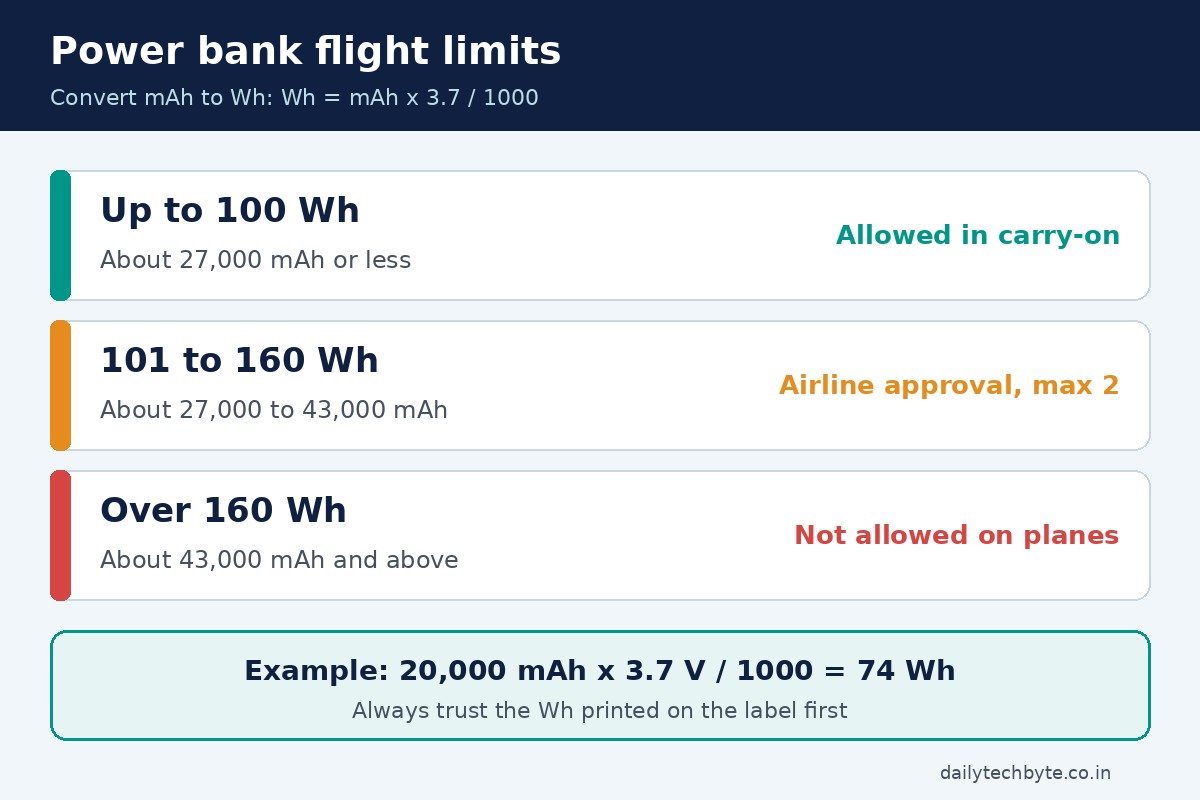
To check if a power bank is allowed on a flight, find its watt-hour (Wh) rating on the label. Up to 100 Wh is generally fine in carry-on bags. Between 100 and 160 Wh needs airline approval. Above 160 Wh is not allowed on passenger planes. And whatever the size, a power bank goes in your cabin bag, never in checked luggage.
Most people only know their power bank by its mAh number, like 10,000 or 20,000. Airlines and security staff think in Wh. So the first job is a bit of simple maths, and that is exactly what this guide walks you through, along with the packing rules and the in-flight rules that have been tightening across airlines.
Why power banks get special attention
A power bank is a lithium-ion battery in a small plastic shell. All lithium-ion batteries can overheat and go into a chain reaction called thermal runaway. It can happen if the battery is damaged, gets too hot, gets wet, is overcharged, or is packed badly. Rarely, it can even happen on its own because of a manufacturing defect.
On the ground that is a nasty fire. In an aircraft cabin it is a much bigger problem. That is why aviation regulators have focused on power banks in particular, and why several airlines have added rules that go beyond the basic limit. Flight crews are trained to deal with these fires, but the best fix is a battery that never gets there.
Step 1: Find the Wh rating on your power bank
Look at the printed label on the back or side of the power bank. Many newer ones print the Wh figure directly, for example “37Wh”. If you see it, you are done. That number is the one that counts.
If the label shows only mAh and voltage, you calculate it yourself:
Wh = (mAh ÷ 1000) × volts
Most power banks use cells rated at 3.7 volts, so the quick version is: mAh × 3.7 ÷ 1000.
| Power bank (mAh) | Approx. Wh at 3.7 V | Carry-on status |
|---|---|---|
| 5,000 | 18.5 Wh | Fine |
| 10,000 | 37 Wh | Fine |
| 20,000 | 74 Wh | Fine |
| 27,000 | About 100 Wh | Right at the limit, check the label |
| 30,000 | 111 Wh | Needs airline approval |
| 40,000 | 148 Wh | Needs airline approval |
| 50,000 | 185 Wh | Not allowed |
A small aside: the mAh on the box is the rating of the internal cells. What you actually get out through the USB port is less, because of conversion losses. For travel rules, though, the cell rating is the number regulators care about, so use the label.
Picture a student carrying a 20,000 mAh bank for a long train-to-flight journey. That is about 74 Wh, so no issue. Now picture a trekker with a rugged 30,000 mAh unit. That is roughly 111 Wh, which sits in the “ask the airline first” band. Same shelf in the shop, very different answer at the airport.
The size limits in plain words
These limits come from the US aviation regulator’s passenger guidance and match the international airline body’s guidance:
- Up to 100 Wh: allowed in carry-on baggage. Since March 27, 2026, international aviation rules limit each passenger to two power banks, and airlines can be stricter.
- 101 to 160 Wh: only with the airline’s approval, and a limit of two spare batteries per person.
- Over 160 Wh: not allowed on passenger aircraft. This covers large power stations and generators.
The same March 2026 international update also bars passengers from recharging a power bank from the aircraft’s power supply during the flight. For anything above 100 Wh, always confirm with your airline before you leave home, because some carriers no longer approve those units at all.
Step 2: Remember that a power bank never goes in checked luggage
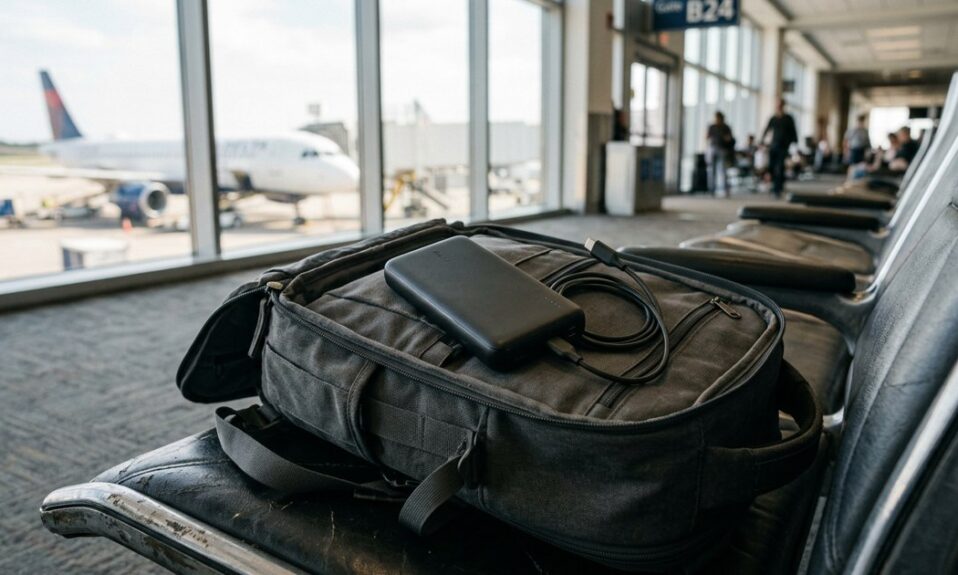
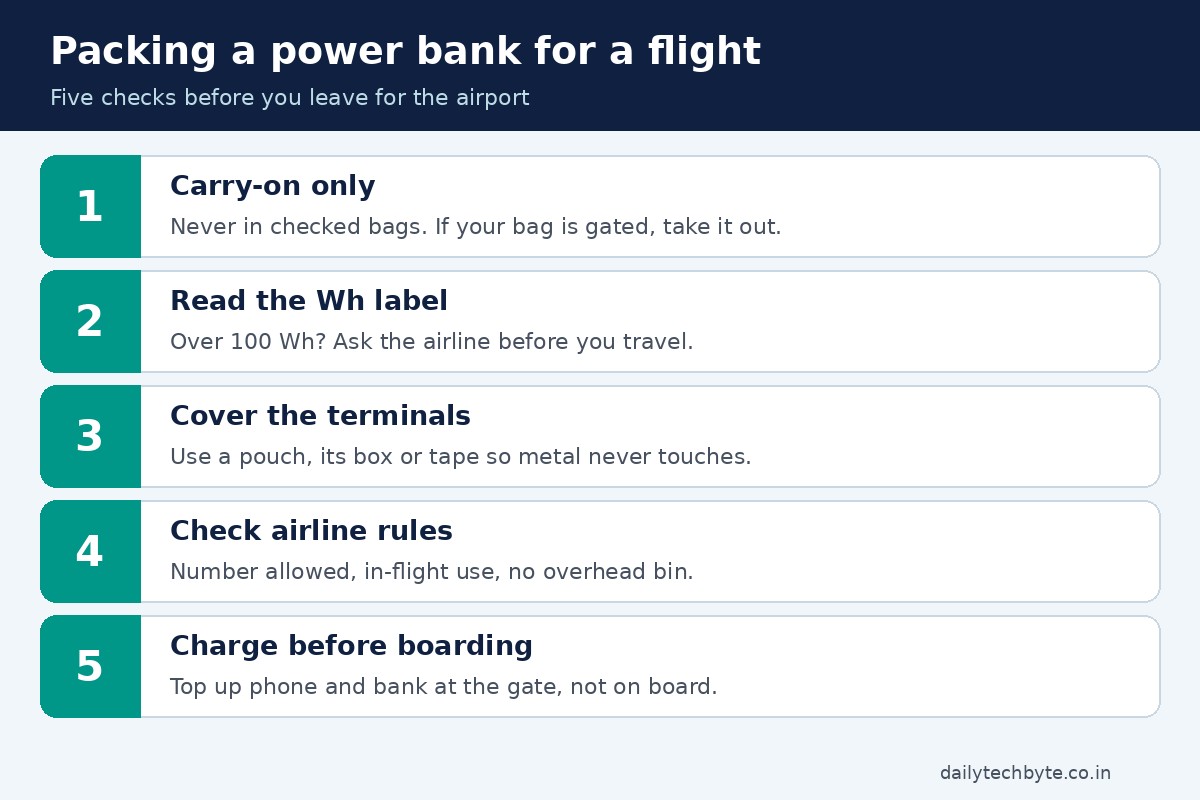
This is the rule that catches people out. Spare lithium batteries, which includes power banks and charging cases, must travel in carry-on baggage only. If you are told at the gate that your cabin bag has to go into the hold, take the power bank out and keep it with you in the cabin.
Security staff can confiscate a power bank that is found in checked baggage or that has no readable rating. Cheap unbranded ones with a rubbed-off or missing label are the usual problem.
Step 3: Protect the terminals
The metal contacts must not touch other metal, such as keys or coins, because that can short-circuit the battery. The easy ways to do it:
- Keep the power bank in its retail box or a soft pouch.
- Cover exposed contacts with tape.
- Put it snugly in a plastic bag or a small case.
For a normal power bank with a USB port and a plastic body, a pouch is enough. I keep mine in a small zipped case with its cable, and it has never been a talking point at security.
Step 4: Check your airline’s own rules
The regulator’s rule is the floor. Airlines are free to be stricter, and many now are. Rules to look for on your airline’s website:
- Maximum number of power banks per passenger
- Whether you can use or charge the power bank during the flight
- Where it must be stored (seat pocket, under the seat, on your person, or not in the overhead bin)
- Whether 100 to 160 Wh units need advance approval
Some major airlines have banned using or charging a power bank on board and do not allow them in overhead bins, so that crew can spot a problem quickly. In India, the aviation regulator has also told passengers not to use or charge power banks during flights and to keep them out of overhead bins. Rules change fast, so read the current version for your carrier a day or two before you fly.
| What to check | US rule (FAA guidance) | India |
|---|---|---|
| Carry-on or checked | Carry-on only | Carry-on only |
| Basic size limit | 100 Wh | 100 Wh |
| 101 to 160 Wh | Airline approval, max two | Airline approval |
| In-flight use | Depends on the airline | Regulator advises against using or charging in flight |
| Overhead bin | Depends on the airline | Regulator advises keeping it out of overhead bins |
Step 5: Do a quick health check before you travel
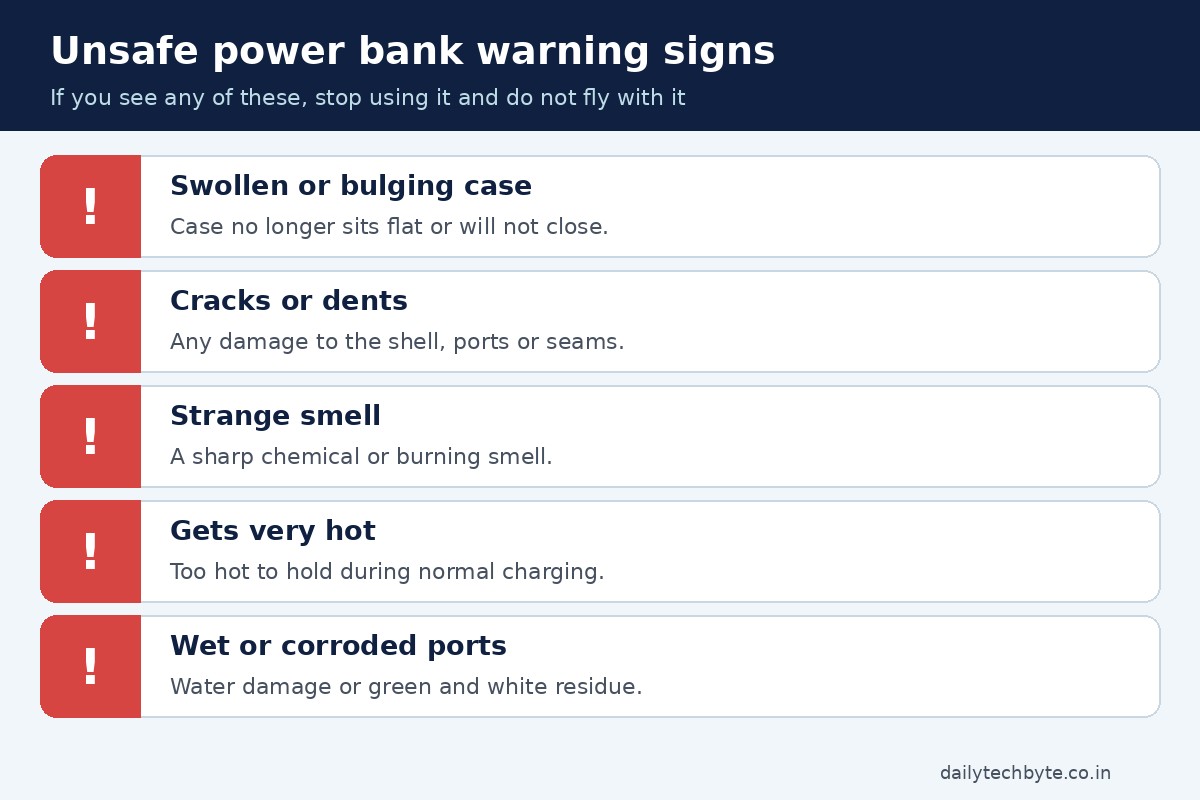
Do not take a damaged power bank on a plane. Look for:
- A swollen or bulging case
- Cracks, dents or a case that no longer closes flat
- A strong or odd smell
- It gets very hot during normal charging
- Wet or corroded ports
If any of these show up, stop using it. Do not carry it, and do not just throw it in the household bin: lithium batteries need a proper e-waste collection point. Also check whether your model has been recalled. Safety regulators publish recall lists, and a recalled battery must not fly.
Buying habits matter too. A power bank from a known maker, with clear Wh rating, safety markings and a model number you can look up, is far less likely to cause a headache than a no-name one at a pavement stall. Good phone habits help as well; if you travel a lot, my guide on preventing SIM swapping is worth a read before your next trip abroad.
What to do if a power bank overheats on board
Tell the cabin crew immediately. Do not wait to see if it settles down. Do not try to pick it up with bare hands if it is smoking. Crew carry equipment and training for this. The fastest report gives them the best chance of containing it.
My simple pre-flight routine
- Read the Wh on the label, or work it out with the formula.
- If it is over 100 Wh, email or call the airline.
- Put the power bank in your cabin bag, in a pouch.
- Charge your phone and the power bank fully before you leave, so you do not need to charge on board.
- Check the airline’s current rule on in-flight use.
That takes about two minutes, and it removes nearly every chance of being stopped at security. Flying to the US or UK? My explainer on how India’s time gap with them changes helps you plan your arrival.
FAQ
How many mAh power bank is allowed on a flight?
A power bank up to 100 Wh is generally allowed in carry-on baggage. At a typical 3.7 V cell rating, that is roughly 27,000 mAh. Always check the Wh printed on the label, because voltage can differ.
Can I put a power bank in checked baggage?
No. Spare lithium batteries, including power banks, must be carried in the cabin. If your bag is checked at the gate, remove the power bank and keep it with you.
How do I convert mAh to Wh?
Divide the mAh by 1000 and multiply by the voltage. For a 20,000 mAh power bank at 3.7 volts, that is 20 × 3.7 = 74 Wh.
Can I use my power bank during the flight?
Usually not. Since March 27, 2026, international rules stop passengers from recharging power banks from the aircraft’s power supply, many airlines ban using them to charge devices on board, and India’s aviation regulator has advised against using or charging them in flight. Check your airline’s current policy before you fly.
What happens if my power bank has no label?
Security staff may refuse it, since they cannot confirm the rating. Buy a power bank with a clear Wh or mAh and voltage label, and retire any with a rubbed-off print.