
Last updated: November 1, 2026 · By Sanket Goyal
Why doesn’t India have daylight saving time? Short answer: India sits close enough to the equator that its days don’t stretch and shrink much between summer and winter, so moving the clock by an hour buys very little extra evening light. Add a single national time zone, a huge farming population that runs on the sun anyway, and the cost of resetting railways, banks and phones twice a year, and the case for it falls apart.
India did try it, though. Briefly, and only during wars. This guide covers why the clocks stay put, when they didn’t, the two time zone debate that keeps coming back, and the one practical thing that does change for Indians every March and November: the time gap with the US and UK.
What daylight saving time actually is
Daylight saving time (DST) means pushing the clock forward by one hour in spring and pulling it back in autumn. The sun doesn’t care. You simply wake up, work and finish “an hour earlier” by the sun, so there’s more daylight left after office hours.
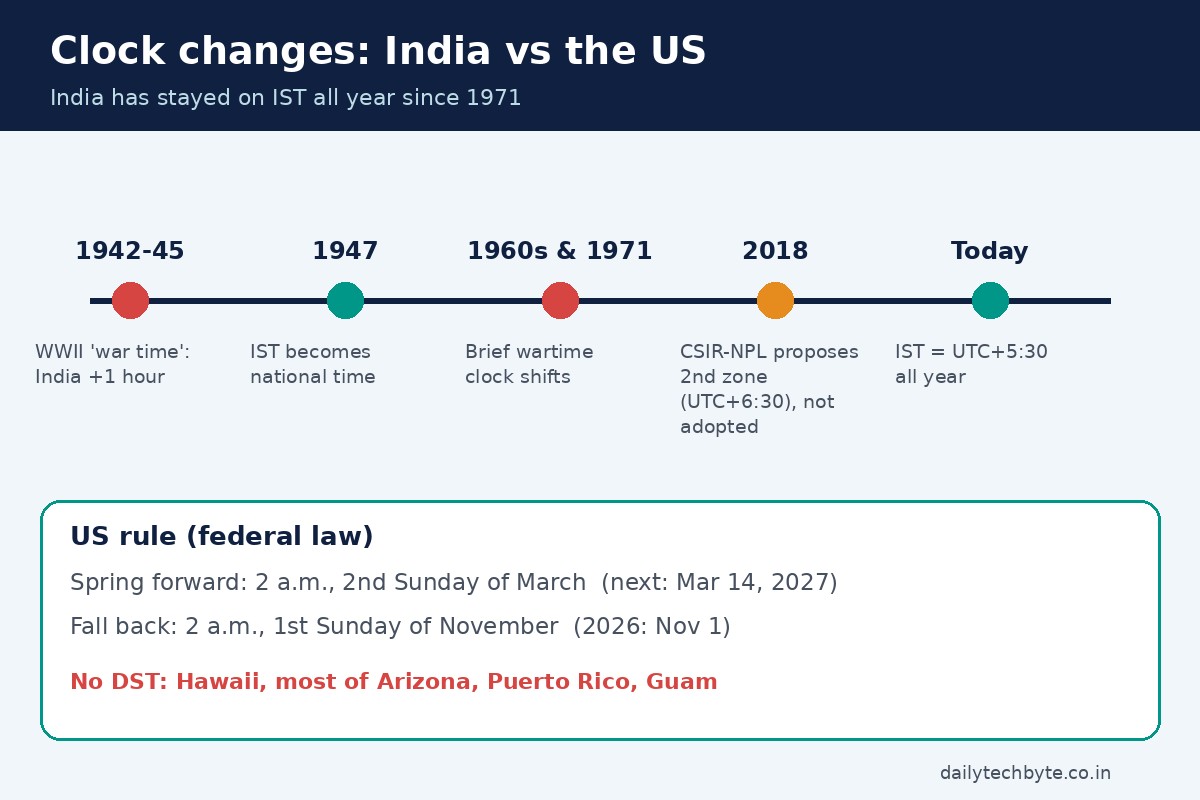
In the US, the rule is fixed by federal law: clocks jump forward at 2 a.m. on the second Sunday of March and fall back at 2 a.m. on the first Sunday of November. In 2026 that meant March 8 and November 1. The next jump forward is March 14, 2027. The UK and most of Europe run a similar system, switching back on the last Sunday of October.
Not everyone in the US plays along. Hawaii and most of Arizona stay on standard time all year, and so do territories like Puerto Rico and Guam. Arizona’s reason is the one that matters for India too: when your summer is already brutally hot, an extra hour of evening sun is not a gift.
Why doesn’t India have daylight saving time? The real reasons
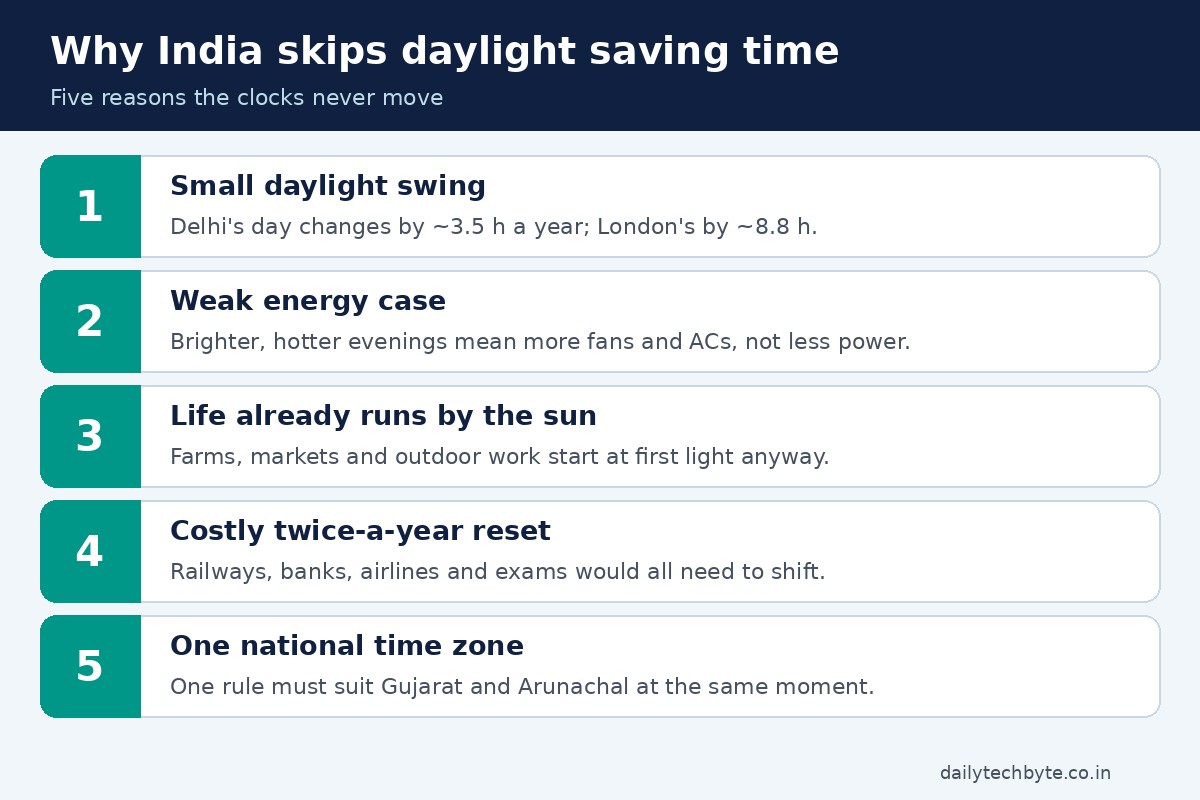
1. Latitude: India’s days don’t swing enough
This is the big one. DST only pays off where summer days are dramatically longer than winter days. That happens far from the equator.
Take London. Its shortest day is under 8 hours of daylight and its longest is over 16 and a half. That’s a swing of more than eight hours, so shifting an hour of light into the evening feels like a real gain.
Now Delhi. The shortest day is roughly 10 hours 20 minutes, the longest close to 14 hours. A swing of about three and a half hours. Go further south to Chennai or Kochi and the gap gets even smaller. When the difference is that modest, there’s no big pile of “wasted” summer morning light to move around.
| Place | Shortest day (approx.) | Longest day (approx.) | Swing |
|---|---|---|---|
| Delhi, India | 10 h 20 min | 14 h | About 3.5 hours |
| London, UK | 7 h 50 min | 16 h 39 min | About 8.8 hours |
2. The energy saving argument is weak here
DST was sold, in many countries, as a way to save electricity: people use less lighting in the evening if it’s still bright outside. In a hot country the trade-off flips. A longer, brighter evening in May often means more fans and air conditioners running, not fewer lights. Researchers in India have argued for years that power grid problems should be handled as a grid question, not by fiddling with the clock.
3. A huge share of India already lives by the sun
Picture a dairy farmer in Haryana. The cows get milked at first light whether the clock says 5 or 6. Same for a vegetable vendor heading to the mandi, a construction crew starting before the heat, or a fisherman on the Kerala coast. Large parts of the country already shift their day to match sunrise without anyone changing a clock. DST is mostly a tool for office-bound, clock-bound economies.
4. Changing the clock twice a year is expensive and risky
Indian Railways runs thousands of trains on a single national timetable. Banks, stock exchanges, airlines, telecom networks, exam boards, courts. Every one of them would need two coordinated resets a year, plus a stretch of confusion each time. Ask anyone who has missed a meeting because a calendar app moved it by an hour. Now scale that to 1.4 billion people.
5. One time zone makes the math awkward
India runs on a single time, Indian Standard Time (IST), which is UTC plus 5 hours 30 minutes. It’s calculated from the 82.5° E line of longitude near Mirzapur in Uttar Pradesh, roughly the middle of the country. Any DST rule would have to suit Gujarat in the far west and Arunachal Pradesh in the far east at the same moment, and those two places already see sunrise nearly two hours apart.
When India did use daylight saving time
India has changed its clocks before. Just never as a routine.
- Second World War (1942 to 1945): the subcontinent ran on “war time”, one hour ahead of normal.
- The wars of the 1960s and 1971: clocks were moved forward again for short periods, mainly to save power during the conflicts.
Since then, IST has stayed the same all year. India officially adopted IST as the national time after Independence in 1947, though Kolkata and Mumbai kept their own local times for a few more years before falling in line.
The real debate: not DST, but two time zones
If you hear people in India arguing about clocks, it’s almost never about DST. It’s about the Northeast.
In winter, parts of the Northeast see the sun rise before 5 a.m. and set around 4:30 p.m. Offices, schools and shops open on IST, which means a good chunk of daylight is gone before anyone starts work. Assam’s tea gardens have long run on an informal “chai bagan” time that is an hour ahead of IST for exactly this reason.
The proposals so far:
- Planning-level recommendations for two time zones came up more than once, without action.
- Assam’s government pushed for its own time more than a decade ago.
- In 2018, scientists at CSIR-NPL, the national lab that keeps India’s official time, proposed two zones: IST-I at UTC+5:30 for most of the country and IST-II at UTC+6:30 for the Northeast, with the dividing line near the Bengal-Assam border.
The Centre has not accepted a split. The reasons given include safety and strategic concerns, plus the practical mess at the border: picture a railway line where the clock changes by an hour halfway through a journey. My own view? A second zone for the Northeast makes more sense than national DST ever would, but the rollout risk is real and nobody wants to own the first train mix-up.
What actually changes for you when the US or UK changes its clocks
Here’s where this stops being trivia. India doesn’t move, but the US and UK do, so the gap between IST and those countries changes twice a year. If you freelance for a US client, work night shifts at a call centre, trade in US stocks, or video-call family abroad, this hits you directly.
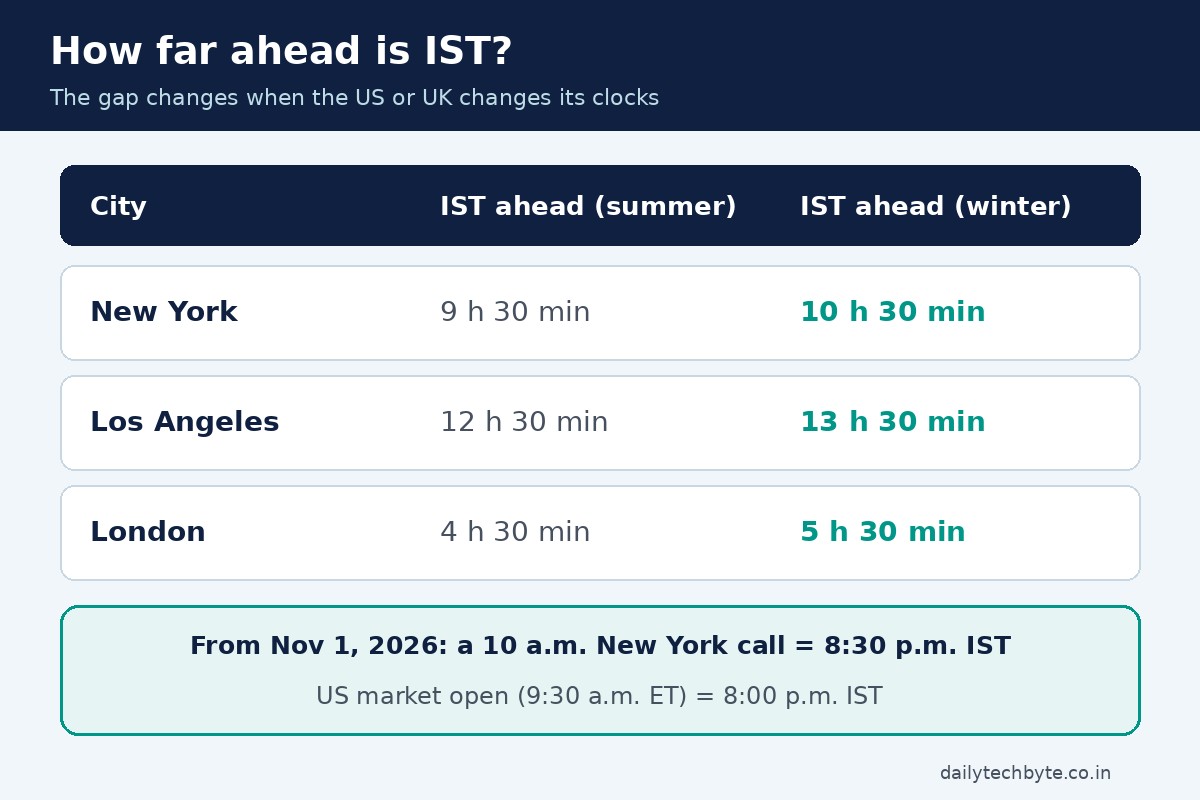
| City | Gap during their summer time | Gap during their standard time |
|---|---|---|
| New York | IST is 9 h 30 min ahead | IST is 10 h 30 min ahead |
| Los Angeles | IST is 12 h 30 min ahead | IST is 13 h 30 min ahead |
| London | IST is 4 h 30 min ahead | IST is 5 h 30 min ahead |
So from November 1, 2026, a 10 a.m. call in New York lands at 8:30 p.m. in India, not 7:30 p.m. A US market opening at 9:30 a.m. Eastern now starts at 8 p.m. IST. Small change, big effect on your evening.
A quick checklist for every March and November
- Check your recurring meetings. Calendar apps usually adjust, but meetings set up in IST by an Indian organiser stay fixed, so the overseas side moves.
- Re-read client deadlines. “End of day Friday, Eastern time” is now an hour later on your clock.
- Tell your team. Picture a support agent on a US shift who logs in an hour early because nobody mentioned the switch. Annoying, and avoidable.
- Leave phone clocks on automatic. Your phone already knows IST never changes. Manual time settings are where mistakes creep in, and they can also break security features. If you care about phone security, my guide on how to prevent SIM swapping covers the settings that matter more.
Should India ever adopt daylight saving time?
Honestly, I don’t think so. The benefit is small at our latitude, the energy logic runs backwards in a hot climate, and the disruption would be huge. Even countries far to the north are questioning DST now: the US House passed a bill in 2026 to make daylight time permanent, though it hasn’t become law, and several Canadian provinces have dropped the twice-a-year switch.
The smarter fix for India’s real clock problem is local. Northeast offices and schools starting earlier, flexible hours for people on overseas shifts, and maybe one day a carefully planned second time zone. Not a national clock change.
If you build content or products for readers in several countries, time zones are just one piece of the puzzle; my guide on SEO for multilingual websites covers the rest. And for another look at how global tech is reaching India, see this piece on Starlink partnering with Jio and Airtel.
FAQ
Has India ever used daylight saving time?
Yes, but only in wartime. India ran clocks one hour ahead during the Second World War (1942 to 1945) and again briefly during the wars of the 1960s and 1971. Since then IST has stayed the same all year.
Does India change its clocks in winter or summer?
No. India stays on Indian Standard Time, UTC plus 5 hours 30 minutes, all year. Only the time gap with countries that use daylight saving time changes.
Why is IST 5 hours 30 minutes ahead of GMT?
IST is based on the 82.5° E longitude line near Mirzapur in Uttar Pradesh, roughly the centre of India. Each 15 degrees of longitude equals one hour, so 82.5 degrees works out to 5 hours 30 minutes ahead of Greenwich.
What is the time difference between India and the US after daylight saving ends?
After November 1, 2026, IST is 10 hours 30 minutes ahead of New York and 13 hours 30 minutes ahead of Los Angeles. When US daylight saving time starts again on March 14, 2027, those gaps shrink by one hour.
Will India get two time zones?
Not for now. Scientists at CSIR-NPL proposed a second zone at UTC+6:30 for the Northeast in 2018, but the Centre has not adopted it, citing strategic and practical concerns.