Last updated: November 3, 2026 · By Sanket Goyal
Short answer: not clearly yet, but the risk is real and it is growing. Studies covering data up to 2024 find no solid proof that data centers pushed household bills up, and one even finds a small drop. Grid operators, though, are now buying power at record caps and running short of supply, and that is where the next pressure on bills could come from.
I know that sounds like a shrug. It is not. The honest picture has three layers: what the research says about the past, what the grid is signalling about the next few years, and what rules decide who pays. Let me take them one at a time.
How much power do data centers actually use?
A lot, and the number is climbing fast. A national lab study backed by the US Department of Energy put US data center use at 176 TWh in 2023, about 4.4% of all US electricity. That was up from 58 TWh in 2014.
The lab’s June 2026 update looks further out. It estimates data centers could reach about 11.8% of US electricity by 2030, inside a scenario range of 9.5% to 15.3%. These are projections, so treat them as a range of possibilities, not a promise.
What is actually inside your electricity bill?
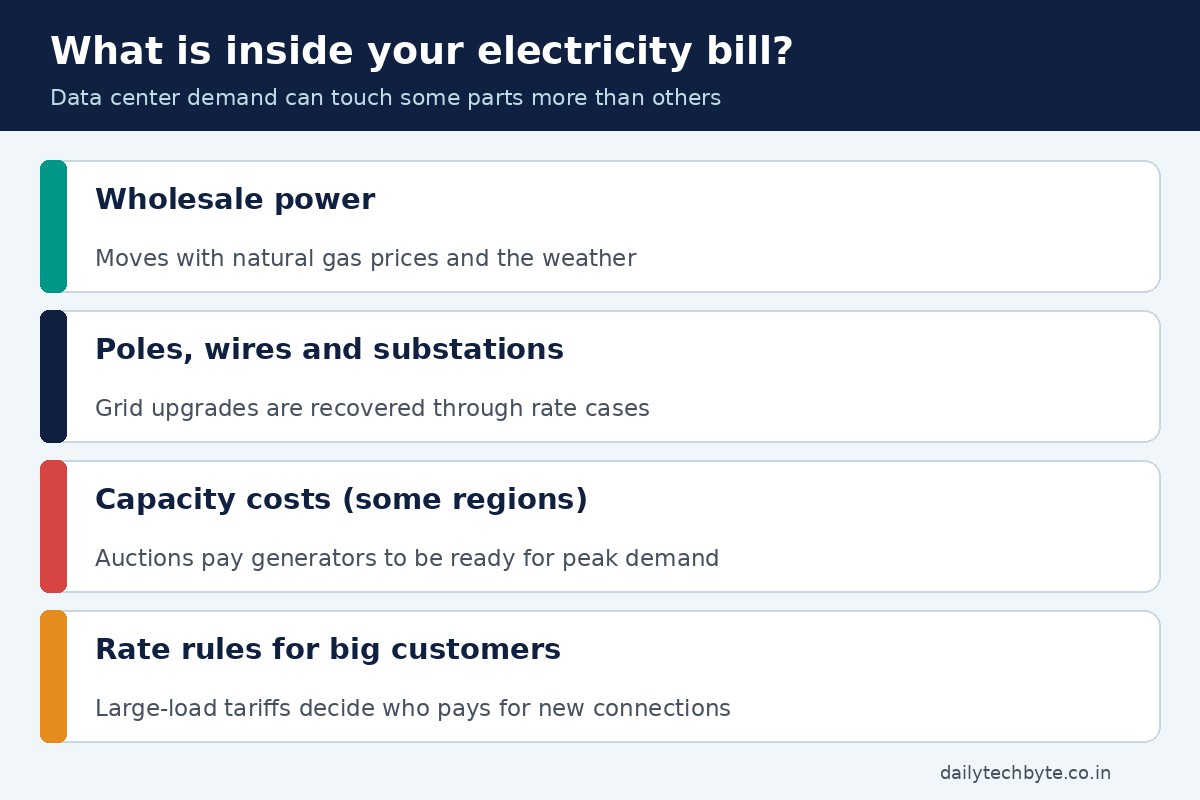
Here is the part most headlines skip. Your bill is not just “the price of power”. The US Energy Information Administration explains that the wholesale price of electricity is only one piece. The rest includes upgrades to the poles, wires and substations, and in some regions the cost of capacity auctions, where grid operators pay generators to be ready for peak demand.
Wholesale prices also move with natural gas prices and the weather. EIA notes that a hot summer and a cold winter storm pushed wholesale prices up this year.
That matters because it makes blame slippery. If your bill rose, a hot summer, a gas price jump, grid upgrades and a data center could all be sitting in the same line item.
What the research says about the past
Two recent studies point the same way, with caveats.
- A utility-industry research institute (June 2026) found that data centers modestly lowered average US retail electricity rates between 2015 and 2024. The logic: the grid has huge fixed costs, and if new demand arrives and stays, those costs are spread over more units of power.
- A university policy lab (June 2026) checked whether bills rose near new data centers. At the level where rates are really set, the utility service area, it found no statistically significant effect. The estimate was roughly 35 cents a month, and that is indistinguishable from zero.
Now the caveats, and they are big. Both studies stop at 2024, before the largest AI-scale campuses came online. The institute’s own paper warns the result may not carry over to much bigger facilities, and that it depends on the grid adding supply affordably. The policy lab says it plainly: “not yet” is not the same as “nothing to worry about”.
What the grid is signalling now
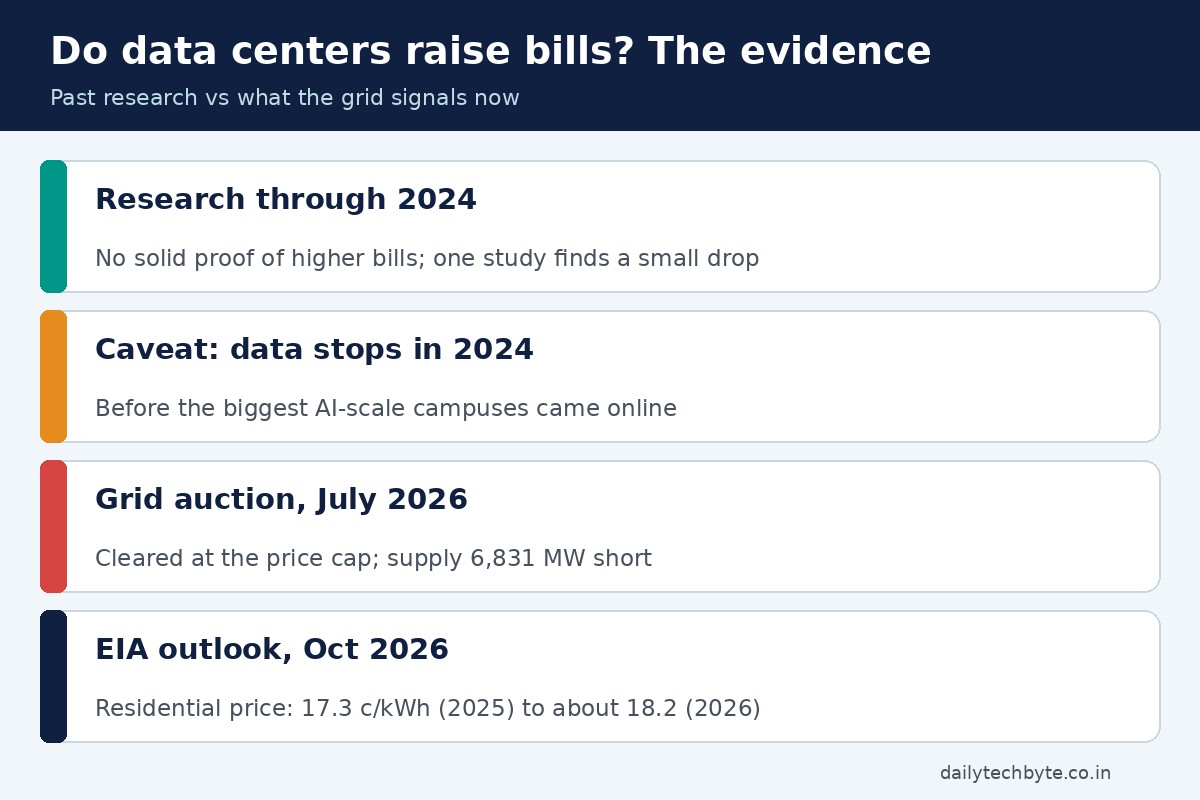
This is the part that made me stop and look twice. The mid-Atlantic and Midwest grid operator, which serves more than 67 million people in 13 states and Washington, D.C., held a capacity auction in July 2026 for the 2028/29 delivery year. The price came in at the cap, $325 per megawatt-day. The previous auction also cleared at its cap, $333.44.
Worse, the supply it secured was 6,831 MW short of the reliability standard. The operator itself said demand is growing faster than supply, and noted that large data center loads keep being added to its forecast. It also said the price cap reduces volatility but does not fix the imbalance.
One caution. The operator also points out that capacity cost is only a fraction of wholesale cost, and wholesale is only part of a retail bill. So “record capacity prices” does not mean “your bill doubles”.
| Signal | What it says | What it means for you |
|---|---|---|
| National lab update (2026) | Data centers could reach about 11.8% of US power by 2030 | Demand is real and rising |
| Research through 2024 | No solid proof of bill increases, one study finds a small drop | Past bills were not mainly a data center story |
| Capacity auction (July 2026) | Cleared at the price cap, supply 6,831 MW short | Pressure is building in that region |
| EIA outlook (Oct 2026) | Residential price 17.3 cents/kWh in 2025, about 18.2 in 2026, about 18.7 in 2027 | Bills are drifting up for many reasons |
Who pays? Large-load tariffs explained
This is the lever that decides the next chapter. A data center is not billed like a house. It is a “large load” customer, and state regulators are writing special rate rules for it.
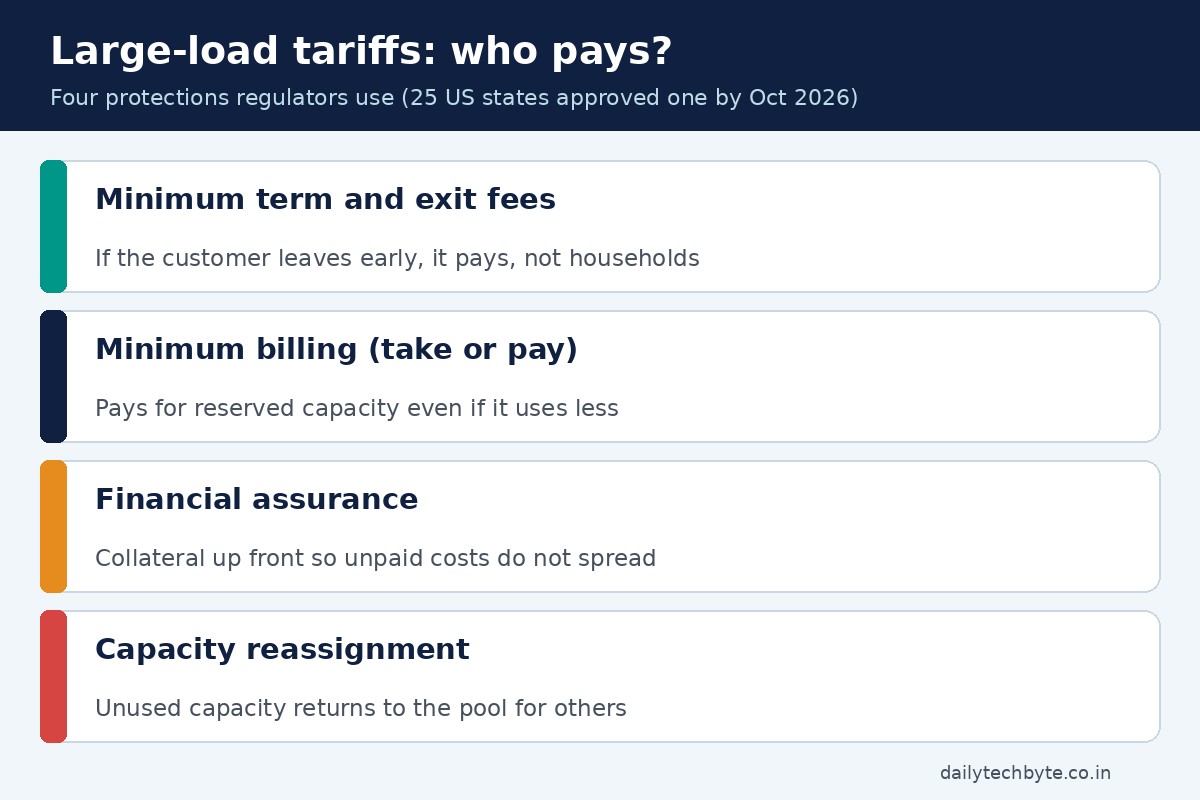
According to a utility-industry summary of commission decisions, as of October 2026, 25 US states had approved at least one large-load tariff, and 8 more had proposals pending. The common protections are easy to picture:
- Minimum term and exit fees: if the customer leaves early, it pays, not you.
- Minimum billing (take or pay): the customer pays for the capacity reserved for it, even if it uses less.
- Financial assurance: collateral up front, so unpaid costs do not land on other customers.
- Capacity reassignment: unused capacity can go back to the pool.
One example from Ohio: new data centers above 25 MW must pay for at least 85% of the energy they expect to need each month, even if they use less. That is the “take or pay” idea in plain numbers.
My opinion: the tariff details matter more than the data center itself. A well-designed tariff can make a big new customer help pay for the grid. A weak one can leave households holding the bill if the project shrinks or never gets built.
What if you live in India?
The same logic applies, with a different referee. Under the Electricity Act, 2003 (Section 62), the electricity regulatory commission determines tariffs, including retail sale of electricity, and it can set different rates by the consumer’s load. In practice your distribution company sells power at rates set by the State Electricity Regulatory Commission. So the question to ask in India is the same: does a large new customer carry its own cost of connection and capacity, or is it spread across everyone?
I am not quoting any Indian data center bill figures here, because I could not verify a reliable one. When a state commission opens a tariff petition, the hearing notice is your chance to read it.
What you can do this month
I will not pretend one household can move the grid. But you are not powerless either.
- Read the line items. Find the supply charge, the delivery charge and any capacity or rider lines. Know which part moved.
- Check your utility’s rate case page. Rate increases go through a regulator. Public comment is usually open.
- Ask one question. “Does our large-load tariff cover the full cost of serving new data centers?” Commission staff can point you to the docket.
- Cut peak use. Run heavy appliances outside the evening peak if your plan has time-of-use rates.
- Track the trend, not one bill. One hot month tells you little. A year of bills tells you more.
If you like reading how public rules shape everyday tech, try my explainer on why India does not have daylight saving time. On the small-gadget side of power, see how to check if a power bank is allowed on a flight. For the connectivity side of the AI build-out, see satellite internet plans in India.
The bottom line
Data centers are a huge new customer on a grid that was not built for them. Research up to 2024 says households were not the ones paying. The next few years are the real test, and the outcome depends on tariffs, new supply and how fast the buildings really arrive. Watch the rules, not just the headlines.
FAQ
Do data centers raise electricity bills?
Not clearly so far. Studies using data through 2024 found no solid evidence of bill increases, and one found a small decline in average rates. The risk is higher going forward, because grid operators are short of supply and the biggest AI-scale campuses are only now arriving.
How much electricity do data centers use?
A national lab estimated 176 TWh in 2023, about 4.4% of US electricity. Its June 2026 update says data centers could reach about 11.8% by 2030, with a range of 9.5% to 15.3%.
What is a large-load tariff?
It is a special rate schedule for very large customers such as data centers. Common terms include minimum contract lengths, exit fees, take-or-pay minimum billing and collateral, so other customers are not left paying for unused infrastructure.
Why are electricity prices going up if data centers are not the main cause?
Bills combine wholesale power, grid upgrades, capacity costs in some regions, fuel prices and weather. The EIA’s October 2026 outlook expects the average US residential price to rise from 17.3 cents per kWh in 2025 to about 18.2 in 2026.
Who decides electricity rates in India?
State Electricity Regulatory Commissions determine retail tariffs for distribution companies under the Electricity Act, 2003, and they can set different rates by consumer load.