Last updated: November 8, 2026 · By Sanket Goyal
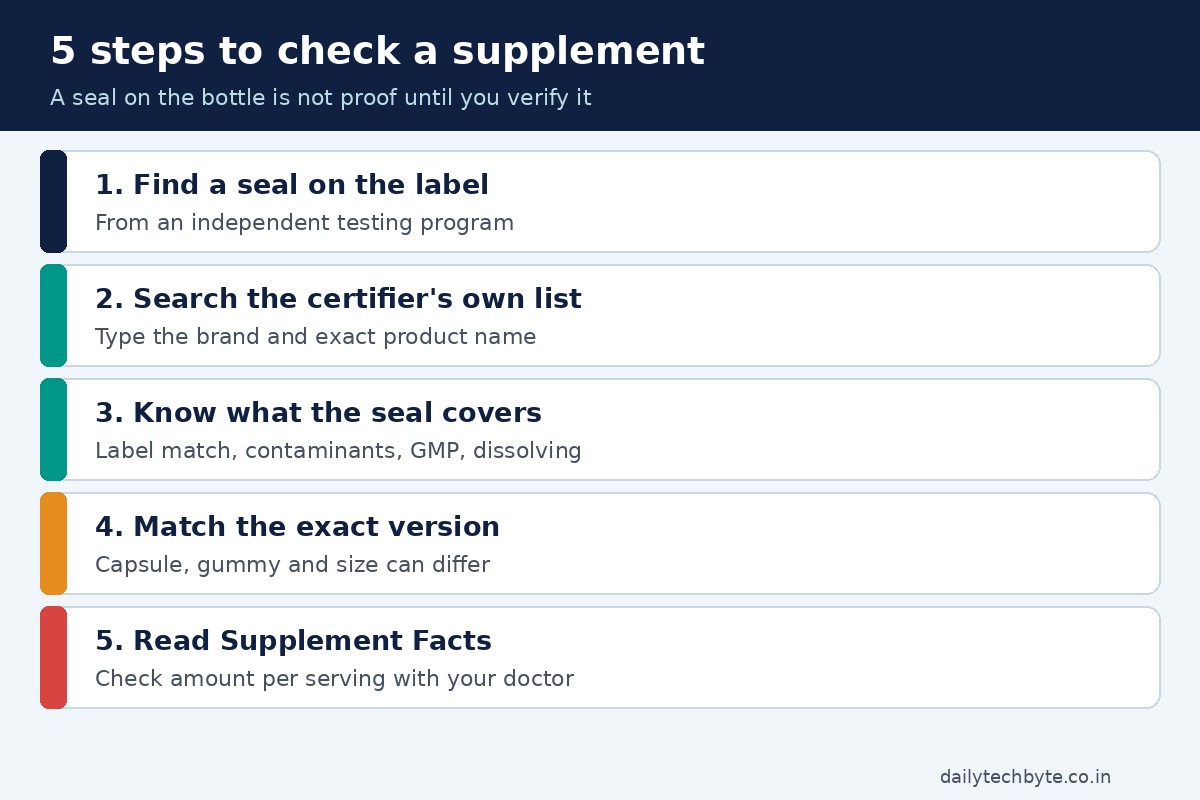
Here is how to check if a supplement is third party tested: look for a quality seal on the label, then confirm it. Search the testing organization’s own list of verified products for the exact product name. A seal printed on a bottle proves nothing until the product shows up in that list.
Why bother? In the US, supplements do not need FDA approval before they are sold. The US Food and Drug Administration does not decide whether a supplement works before it hits the shelf. So an independent lab check is one of the few outside signals you can get. Below is a simple routine, a table of what each check tells you, what seals cannot promise, and how India’s rules differ.
What “third-party tested” actually means
A third party is a lab or program that is not the company selling the pill. It tests the product, or audits how it is made, and lets the maker display a seal if the product passes.
The US National Institutes of Health describes it this way: several independent organizations offer quality testing and let products that pass display a seal. Such a seal indicates the product was properly manufactured, contains the ingredients listed on the label, and does not have harmful levels of contaminants. The same page adds a key caution. These seals do not guarantee that a product is safe or effective.
Hold both ideas together. A seal is a quality check on what is in the bottle. It is not a medical endorsement.
The 5-step check I use
Step 1: Find the seal on the label
Turn the bottle around. Look for a mark from an independent program. The NIH Office of Dietary Supplements names three organizations that offer quality testing: ConsumerLab.com, NSF International and the U.S. Pharmacopeia (USP). It also states that naming them is not an endorsement.
No seal at all? That does not make the product unsafe. It only means no outside program has vouched for it.
Step 2: Do not trust the picture, trust the list
Anyone can print a lookalike badge. So do the real check. USP says the USP Verified Mark on a label shows the product meets its standards, and it runs a product finder where you can search all USP Verified products. Use the finder, type the brand and product name, and see if your exact bottle is there.
The same logic applies to any other certifier. Open their site, search the product, and match the name, the form (capsule or gummy) and, where shown, the strength.
Step 3: Know what the seal covers
USP lists what its verified mark means. The product contains the ingredients on the label in the declared strength and amounts. It has no harmful levels of specified contaminants, such as heavy metals and pesticides. It was made following FDA Good Manufacturing Practices. And it will break down and dissolve in a set time so the ingredients can be released.
Notice what is missing: any promise that the supplement will improve your health. That is a different question.
Step 4: Match the exact product
Brands often sell many versions of one product. A verified vitamin D softgel does not make the same company’s gummy verified. Check the exact name, flavor and size in the list. When in doubt, skip it and ask the certifier or the seller.
Step 5: Read the rest of the label
Every product sold as a supplement carries a Supplement Facts label. It lists active ingredients, the amount per serving and other ingredients such as fillers, binders and flavorings. The NIH notes that manufacturers must follow Good Manufacturing Practices so that identity, purity, strength and composition are right.
Compare the per-serving amount with what your doctor or pharmacist suggested. More is not better. The NIH warns that taking more than you need costs more and may raise the risk of side effects.
What each check tells you
| Check | What it can tell you | What it cannot tell you |
|---|---|---|
| Seal on the label | An outside program may have tested it | That the seal is real |
| Product found on certifier’s list | The exact product was verified | That it works for you |
| Supplement Facts label | Ingredients and amount per serving | Whether the dose suits your body |
| FDA approval claim | Nothing, supplements are not approved | Safety or effectiveness |
| Doctor or pharmacist advice | Whether it fits your health and medicines | Lab quality of one batch |
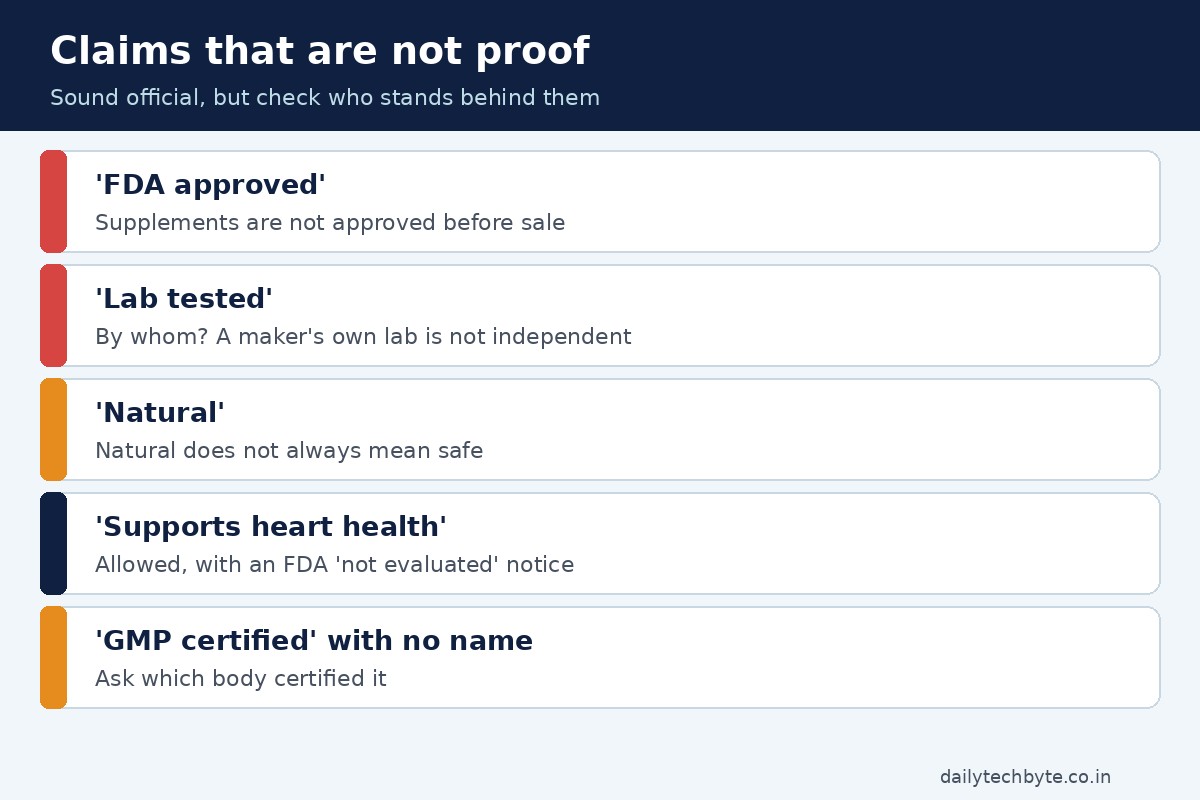
Common label claims that are not proof
Plenty of bottles use words that sound official but are not independent tests.
- “FDA approved.” The FDA does not approve dietary supplements for safety and effectiveness before they are sold. Treat this line as a red flag.
- “Lab tested.” Tested by whom? A maker’s own lab is not a third party.
- “Natural.” The NIH says natural does not always mean safe. Some all-natural botanical products, for example comfrey and kava, can harm the liver.
- “Supports heart health” or “boosts immunity.” Makers may use claims like these, but the label must also say the statement has not been evaluated by the FDA and that the product is not intended to diagnose, treat, cure or prevent any disease.
- “GMP certified” with no name. Manufacturers are required to follow Good Manufacturing Practices anyway. Ask who certified it.
Picture a night-shift nurse who buys a magnesium product online because the page says “lab tested”. She finds no seal and no certifier name. She walks to the pharmacy counter, asks the pharmacist, and picks a verified product from the list. Five minutes, no drama.
What to do if a supplement makes you feel unwell
Stop taking it and tell your health care provider. The NIH says a provider may report the reaction to the FDA, and you can also report it yourself by calling 800-FDA-1088 or using the online form. Also tell the manufacturer, using the contact details on the label.
Keep the bottle and the lot number. Take a clear photo of the label and the Supplement Facts panel. Those details help anyone who investigates.
Supplements bought in India
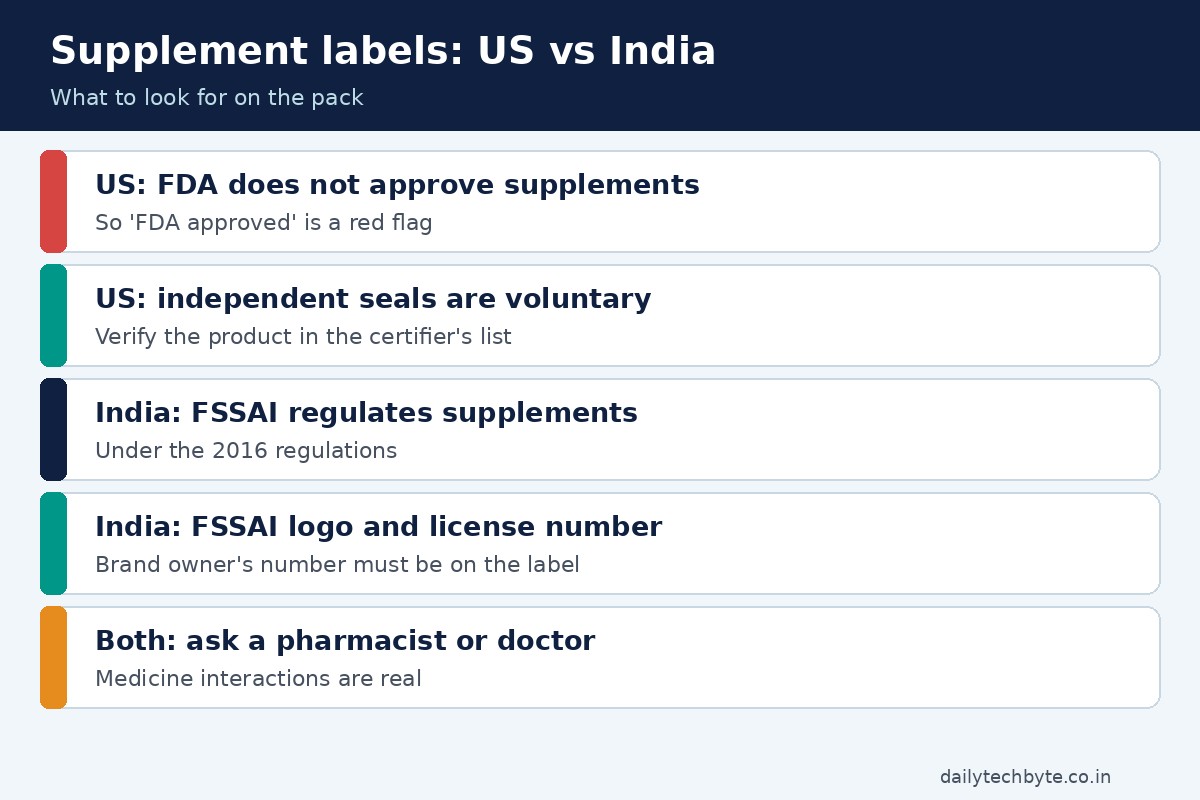
India handles supplements under food law. The FSSAI (Food Safety and Standards Authority of India) sets standards for health supplements and nutraceuticals under the Food Safety and Standards (Health Supplements, Nutraceuticals, Food for Special Dietary Use, Food for Special Medical Purpose, Functional Food and Novel Food) Regulations, 2016.
On the label, the FSSAI logo and license number of the brand owner must be displayed. If the manufacturer, marketer or packer holds a different license, that license number must also appear.
So in India, add one check to the five above: find the FSSAI license number on the pack. A license number is not a lab report, and I would not treat it as one. It does show the seller is registered with the food regulator. Independent seals, where a product carries one, are an extra layer on top.
| Check | US | India |
|---|---|---|
| Regulator | FDA oversees labeling, marketing and safety | FSSAI sets standards under its 2016 regulations |
| Pre-sale approval | Not required for supplements | Follow FSSAI rules and licensing |
| License number on label | Not applicable | FSSAI logo and license number required |
| Independent seals | Voluntary, from outside programs | Voluntary, where a product carries one |
Shopping safely online
Marketplaces make fake badges easy to copy. A few habits help.
- Search the certifier’s list first, then buy that exact product.
- Buy from the brand’s own store or a pharmacy when you can.
- Check the lot number and expiry date when the parcel arrives.
- Be careful with deals far below the usual price. I would not gamble on those for something you swallow every day.
- Watch for recall notices. The NIH points to the FDA’s website for recall notices and says you can subscribe to FDA emails about recalls, market withdrawals and safety alerts.
If you are buying supplements as presents, my guide on budgeting for Christmas gifts can help you set a limit first. And for another smart purchase check, see how to check a used phone before buying.
Talk to a professional first
Testing tells you about quality. It does not tell you whether a supplement is right for you. The NIH says some supplements can interact with medicines. Examples it gives: vitamin K can reduce the ability of the blood thinner warfarin to prevent clotting, and St. John’s wort can speed the breakdown of many medicines and reduce their effectiveness.
Tell your doctor, dentist, pharmacist or dietitian about everything you take. Also tell them before surgery. Be extra careful if you are pregnant or nursing, and before giving any supplement to a child, unless a provider recommends it.
Supplements are also not medicines. The NIH says they are not intended to treat, diagnose, mitigate, prevent or cure diseases.
Related reading on this site
Online safety matters when you shop for health products too. My piece on spotting an AI voice clone scam call and the guide to spotting AI phishing emails cover scams that often come with fake “health deals”.
The bottom line
Find the seal, then verify it in the certifier’s own list. Match the exact product. Ignore “FDA approved” claims. In India, look for the FSSAI license number as well. And before you start anything new, ask a pharmacist or doctor.
If this helped, share it with someone who buys vitamins online. Then explore more practical guides here on DailyTechByte.
FAQ
What does third-party tested mean for a supplement?
It means an independent organization tested the product, or audited how it is made, and allowed a seal on the label if it passed. The NIH says such seals suggest correct manufacturing, label-matching ingredients and no harmful contaminant levels, but do not guarantee safety or effectiveness.
Does the FDA approve dietary supplements?
No. In the US, supplements do not need FDA approval before they are marketed. Medicines do. Companies are responsible for having evidence that their products are safe and that label claims are truthful.
How do I verify a USP Verified supplement?
Use the USP Verified product finder and search the brand and product name. If your exact product is not listed, do not rely on the mark you see on the bottle.
Is a supplement without a seal unsafe?
Not necessarily. It simply has no independent quality check that you can confirm. You may prefer a verified product, especially for items you take daily.
What should I look for on supplements sold in India?
Check the FSSAI logo and license number on the label, as the labeling rules require. Independent seals are voluntary extras. Ask a pharmacist or doctor if you are unsure.
How do I report a bad reaction in the US?
Tell your health care provider, who may report it to the FDA. You can also call 800-FDA-1088 or use the FDA online form, and tell the manufacturer using the contact details on the label.