
Last updated: November 7, 2026 · By Sanket Goyal
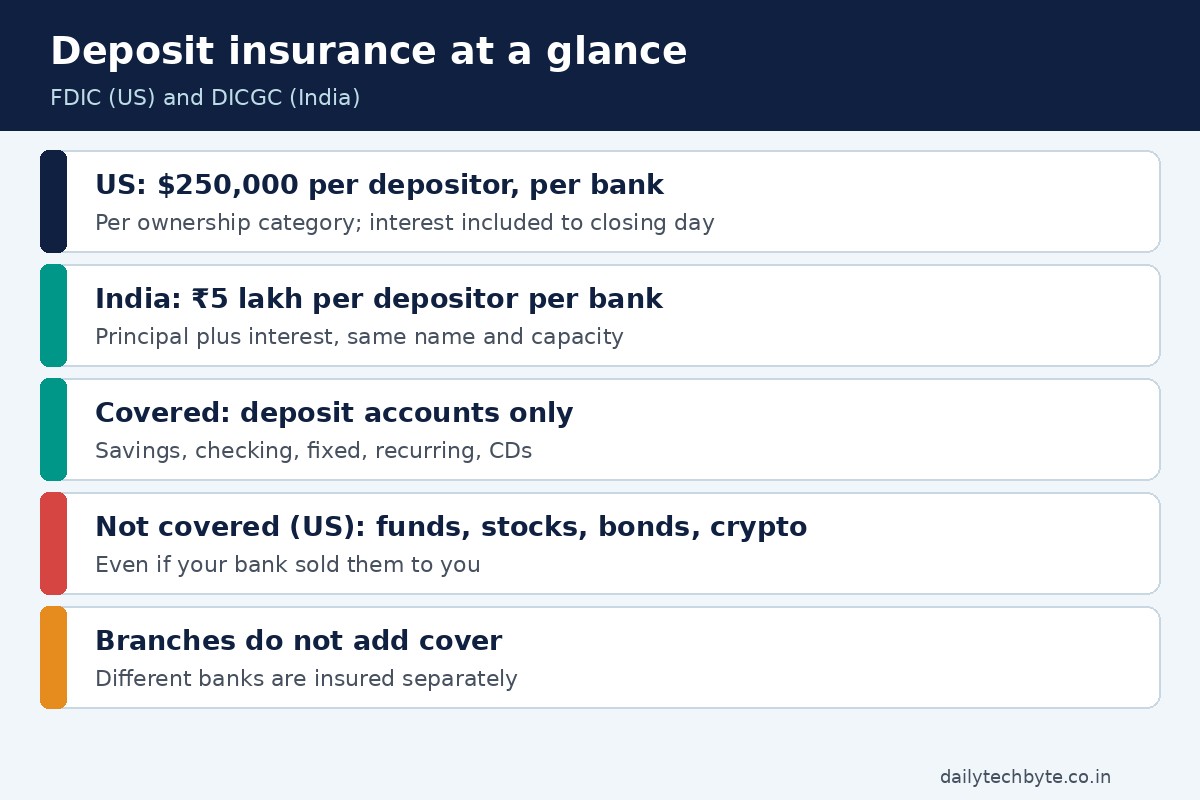
If a bank fails, what happens to your money depends on one thing: whether the deposit is insured. In the United States the FDIC covers at least $250,000 per depositor, per insured bank, per ownership category. In India the DICGC covers up to ₹5 lakh per depositor per bank. Anything above that limit is not guaranteed.
Bank trouble in the news makes people stare at their balance and wonder. Fair enough. The good news is that the rules are simple once you see them laid out, and most people can check their own exposure in ten minutes. Here is what happens, what is covered, and the small moves that make your money safer without any drama.
What does “a bank fails” actually mean?
A bank fails when a regulator closes it because it cannot meet its obligations to depositors and others. It is not the same as a bad quarter or a falling share price. Regulators step in, take control, and decide how the bank is sold, merged or wound up.
For you as a depositor, the key question is not why it failed. It is where your money sits: inside the insurance limit or above it.
What happens in the US
The FDIC acts in two roles. First, it is the insurer, so it pays insured depositors up to the limit. Second, it becomes the receiver of the failed bank, sells or collects the assets and settles debts, including claims above the insured limit.
The standard insurance amount is $250,000 per depositor, per insured bank, for each ownership category. It covers principal plus interest up to the day the bank closes. The FDIC says that since it was created in 1933, no depositor has lost a penny of insured deposits.
A few details trip people up:
- Separate branches of the same bank are not separately insured. They count as one bank.
- Deposits at a different insured bank are insured separately.
- Different ownership categories at the same bank, such as a single account and a joint account, are insured separately.
- You do not have to be a citizen or a resident to be insured.
The FDIC mails a written notice to each depositor at the address on record soon after a bank closes. If another bank takes over, that bank also writes to you.
What the FDIC does not cover
Deposit insurance covers deposits: checking, savings, money market deposit accounts and certificates of deposit. It does not cover stocks, bonds, mutual funds, annuities, life insurance policies, Treasury bills, municipal securities, crypto assets or the contents of a safe deposit box. This holds even when a bank sells you the product. A mutual fund bought through your bank branch is not a deposit.
What happens in India
India’s deposit insurer is the DICGC, a subsidiary of the Reserve Bank of India. Each depositor in a bank is insured up to ₹5,00,000 for principal and interest together, held in the same right and capacity. That limit has applied since February 4, 2020, and the DICGC’s annual report for 2025-26 says the coverage limit stayed unchanged during the year.
You may have seen reports of a proposal to raise the limit. A proposal is not a rule. Until the DICGC itself announces a change, plan around ₹5 lakh.
How the ₹5 lakh limit is counted
All your savings, fixed, current and recurring deposits in the same name at one bank are added together, across every branch, and the total is capped at ₹5 lakh. Here is the DICGC’s own style of example. If you hold ₹4,95,000 as principal and ₹4,000 as interest, the insured amount is ₹4,99,000. If the principal alone is ₹5 lakh, the interest on top is not insured, simply because it is over the limit.
Different banks are insured separately. Joint accounts count as a different capacity from your single accounts. For joint accounts, names in the same order are added together, while the same people listed in a different order are treated as separate accounts.
One more catch. If you owe the bank money, such as a loan, the bank can set off its dues against your deposit. Insurance is paid after that netting.
Who is covered and who is not
All commercial banks, including branches of foreign banks, local area banks and regional rural banks, are insured. At present all co-operative banks are covered too. Primary cooperative societies are not insured. Deposits of the Central and State governments, inter-bank deposits and deposits received outside India are excluded.
How fast do you get paid?
Timing is where India’s rules improved. Since September 1, 2021, if the RBI places a bank under All-Inclusive Directions, which restrict withdrawals, the DICGC must settle insurance claims within 90 days, provided the bank sends the depositor list within 45 days. If a bank goes into liquidation, the DICGC pays the liquidator within two months of receiving the claim list, and the liquidator pays you. The DICGC does not deal with depositors directly in that case.
US and India side by side
| Point | United States (FDIC) | India (DICGC) |
|---|---|---|
| Limit | $250,000 per depositor, per bank, per ownership category | ₹5 lakh per depositor per bank |
| Interest included? | Yes, up to the closing date | Yes, inside the ₹5 lakh |
| Covered products | Checking, savings, MMDA, CDs | Savings, fixed, current, recurring |
| Not covered | Stocks, bonds, mutual funds, crypto, safe deposit box contents | Government and inter-bank deposits, deposits received outside India |
| Who pays the premium | Banks | Banks |
| Branches | Counted as one bank | Counted as one bank |
A quick way to check your own exposure
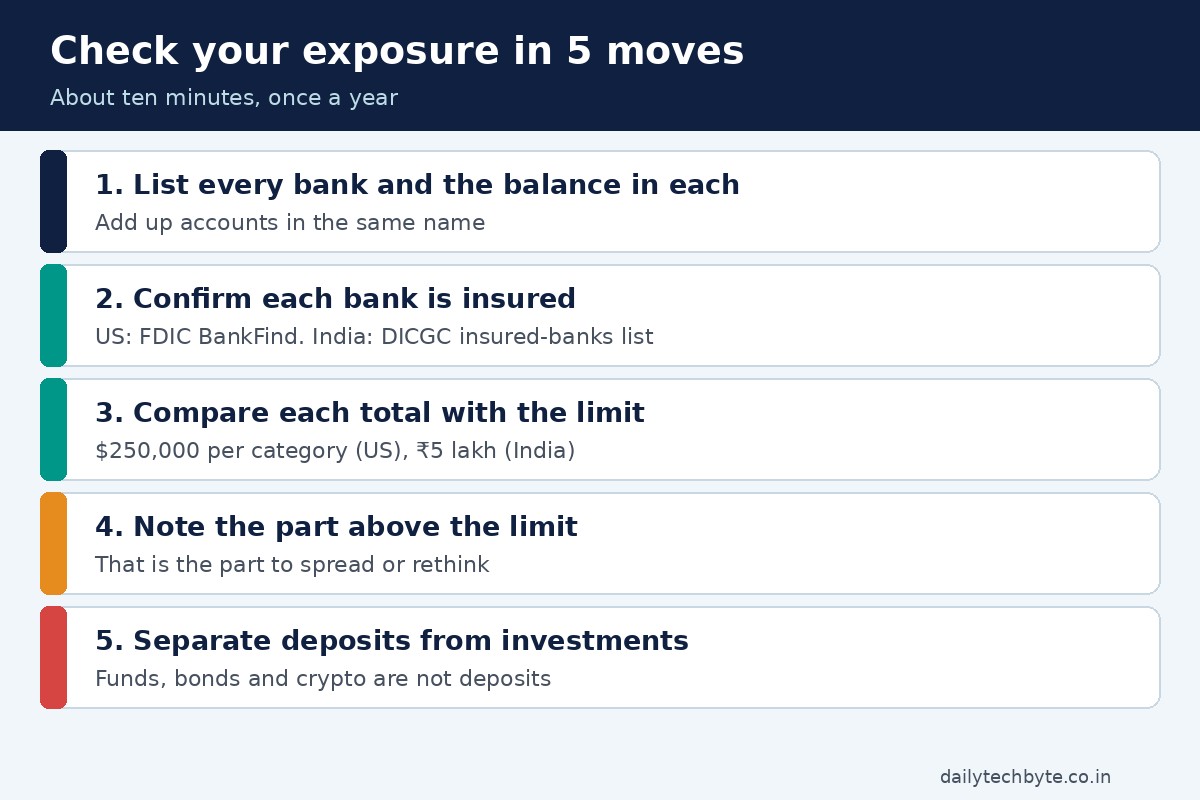
I do this once a year, and again whenever a headline spooks me. It takes less time than making tea.
- Write down every bank where you hold money, and the total in each.
- Check each one is insured. In the US, use the FDIC’s BankFind search. In India, look for the bank on the DICGC’s list of insured banks.
- Compare each total with the limit. Anything above is the part to think about.
- In the US, use the FDIC’s electronic estimator if you hold joint, retirement or trust accounts.
- Look at what is not a deposit: funds, bonds, crypto and anything held outside a bank.
Smart ways to stay safe above the limit
Nobody needs to panic. A few ordinary habits do the job.
- Spread large balances across banks. Each insured bank gets its own limit. A business owner with a big cash cushion might split it between two or three banks.
- Use ownership categories (US). A single account plus a joint account at the same bank are insured separately. So is an IRA.
- Use capacity rules (India). A joint account is a different capacity from your own account, so it carries its own cover.
- Keep deposits and investments apart in your mind. A fund sold by a bank is an investment. Its value can fall, and it is not insured like a deposit.
- Do not chase an extra half percent. If a small, unfamiliar bank offers a much higher rate on a balance above the limit, ask what you are being paid to risk.
What to do if your bank is closed
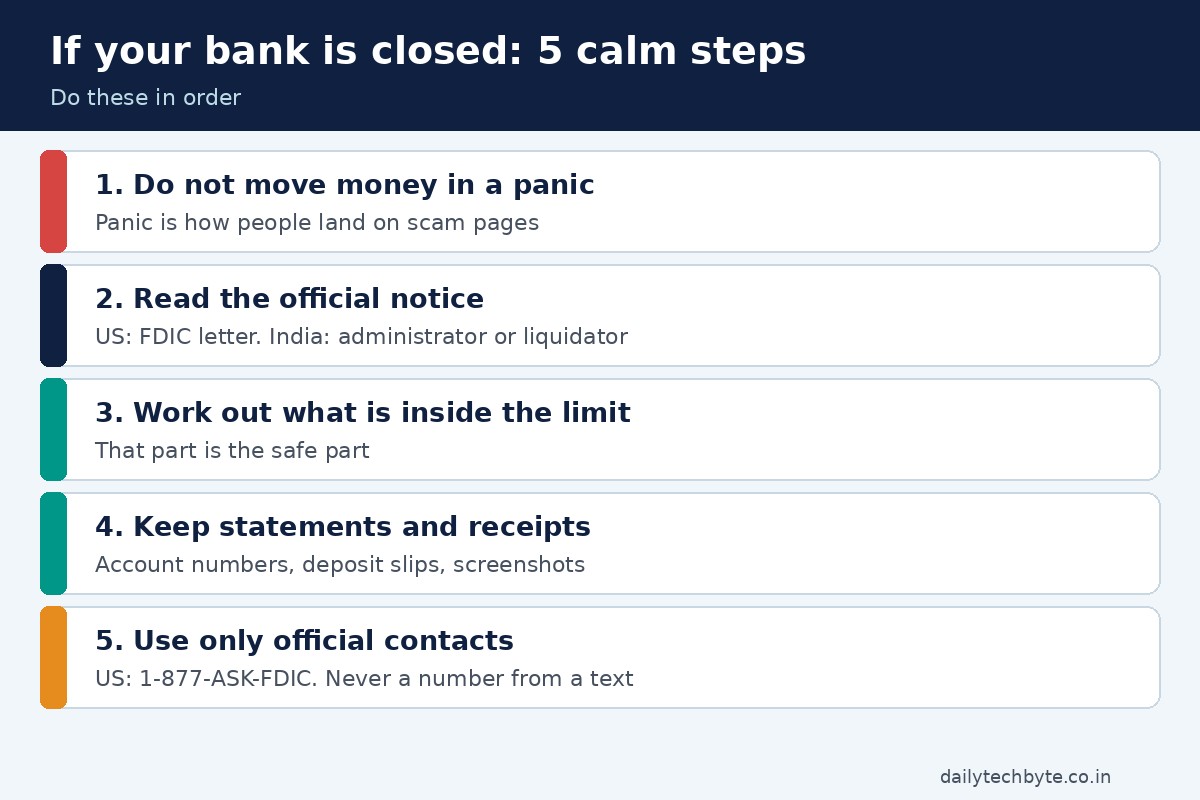
Stay calm and do these in order.
- Do not rush to move money into random accounts or apps. Panic is how people end up on scam pages.
- Read the official notice. In the US the FDIC writes to you. In India, follow the instructions of the bank’s administrator or liquidator and the DICGC.
- Check how much of your money is inside the limit. That part is the safe part.
- Keep your records: statements, deposit receipts and account numbers.
- Be careful with calls and messages. Scammers love a bank failure. Only use phone numbers and websites you find yourself on official sites. The US number to confirm coverage is 1-877-ASK-FDIC.
If a scam does catch you, my guide on what to do after a data breach walks through the first 48 hours, and how to spot AI phishing emails helps you recognise the fake “claim your refund” messages that follow bank news.
What about money outside banks?
Deposit insurance only protects deposits at insured banks. It does not cover crypto held on an exchange, and it does not cover a company that is not an insured bank. I wrote about that gap in what happens if a crypto exchange gets hacked. Read it before you treat any app balance as if it were a bank deposit.
The bottom line
Bank failures are rare, and insured depositors are paid. The FDIC says no insured depositor has lost a penny since 1933, and India now has a 90-day clock for claims once a bank is under withdrawal limits. Your job is small: know the limit, know which bank holds what, and keep large sums spread sensibly. Do that and a scary headline stays just a headline.
If this helped, share it with someone who keeps a large balance in one account. That conversation is worth five minutes.
FAQ
Is my money safe if my bank fails?
Insured deposits are safe up to the limit. In the US that is at least $250,000 per depositor, per bank, per ownership category. In India it is ₹5 lakh per depositor per bank, including interest.
How long does it take to get money back in India?
If a bank is placed under All-Inclusive Directions, the DICGC must settle claims within 90 days, provided the bank sends the depositor list within 45 days. In liquidation, it pays the liquidator within two months of receiving the claim list.
Are fixed deposits covered by deposit insurance in India?
Yes. Savings, fixed, current and recurring deposits are covered, but all of them in the same name at one bank are added together and capped at ₹5 lakh.
Does FDIC insurance cover crypto or mutual funds?
No. The FDIC does not insure stocks, bonds, mutual funds, annuities, crypto assets or safe deposit box contents, even if a bank sold them to you.
Can I get more cover by opening many accounts at one bank?
Not in the same ownership category. Accounts in the same capacity at one bank are added together. Using another bank, or a different ownership category, is what adds separate cover.