Last updated: November 4, 2026 · By Sanket Goyal
Here is how to tell if a job offer email is fake: ask whether it wants your money, your sensitive details, or a deposited check before you have really been hired. An honest employer never charges you to get a job. If the offer arrived without an interview, promises big pay for little work, or sends a check, treat it as a scam until proven otherwise.
I have seen smart people fall for these. Not because they were careless, but because they were hopeful, and hope is exactly what the scammer sells. This guide gives you eight checks you can run in about ten minutes, plus what to do if you already paid.
Why fake job offers work so well
Scammers advertise jobs the same way honest employers do: on job sites, in social media posts, in newspapers, sometimes even on TV and radio. So where you saw the job proves nothing. What they want is your money and your personal information.
Picture a final-year student who has sent forty applications. An email lands saying “You are selected”. Relief arrives before suspicion does. That gap is the scammer’s whole business model.
Eight checks before you reply
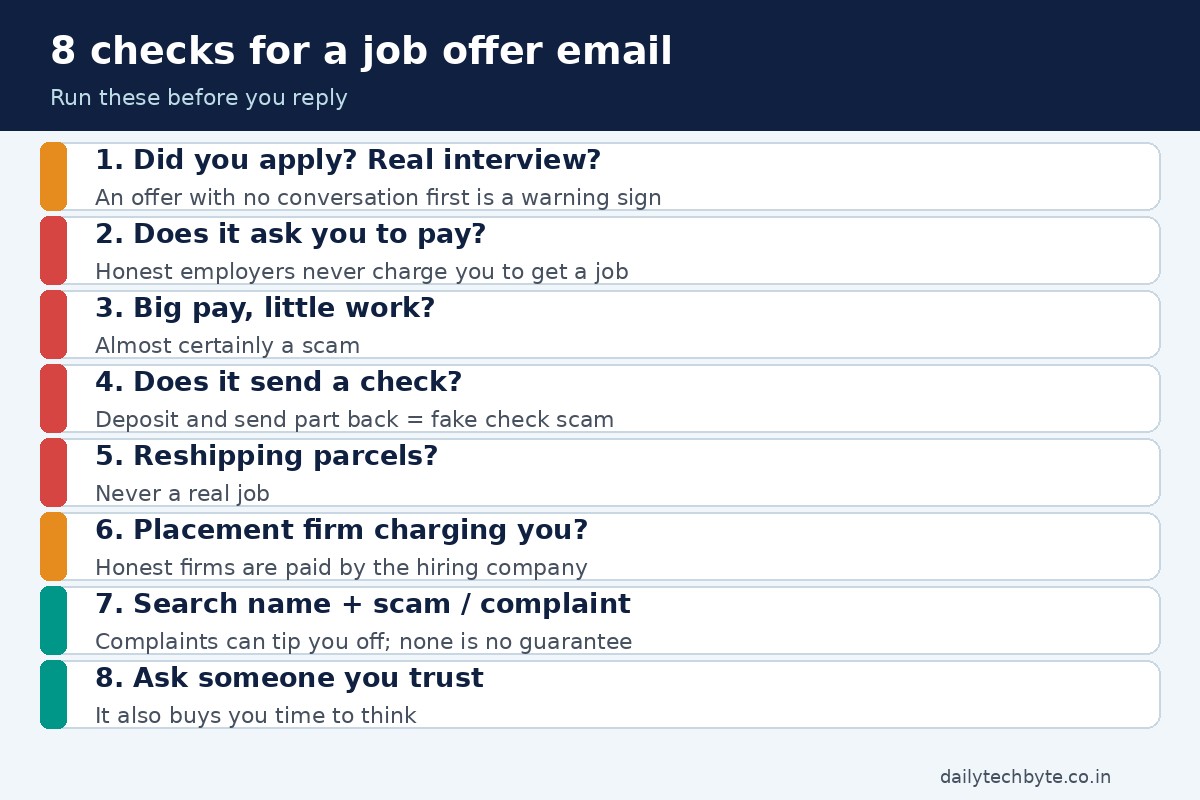
- Did you apply, and was there a real interview? An offer with no conversation first is a warning sign.
- Does it ask you to pay? Fees for training, a starter kit, a certification or “registration” are red flags. Honest employers, including the US federal government, never ask you to pay to get a job.
- Does it promise a lot of money for little work? Big earnings in a short time with little effort is almost certainly a scam.
- Does it send a check? If you are told to deposit it and send part of the money onward, or buy gift cards, that is a fake check scam. Walk away.
- Is the “job” receiving and reshipping parcels? Reshipping goods is never a real job.
- Is a placement firm charging you? Honest placement firms do not usually charge candidates. The hiring company pays them.
- Does the company check out? Search the company or recruiter name with the words “scam”, “review” or “complaint”. No complaints does not prove honesty, but complaints can tip you off.
- Did you talk to someone you trust? Describe the offer to a friend or family member. It also buys you time to think.
The fake check trick, explained
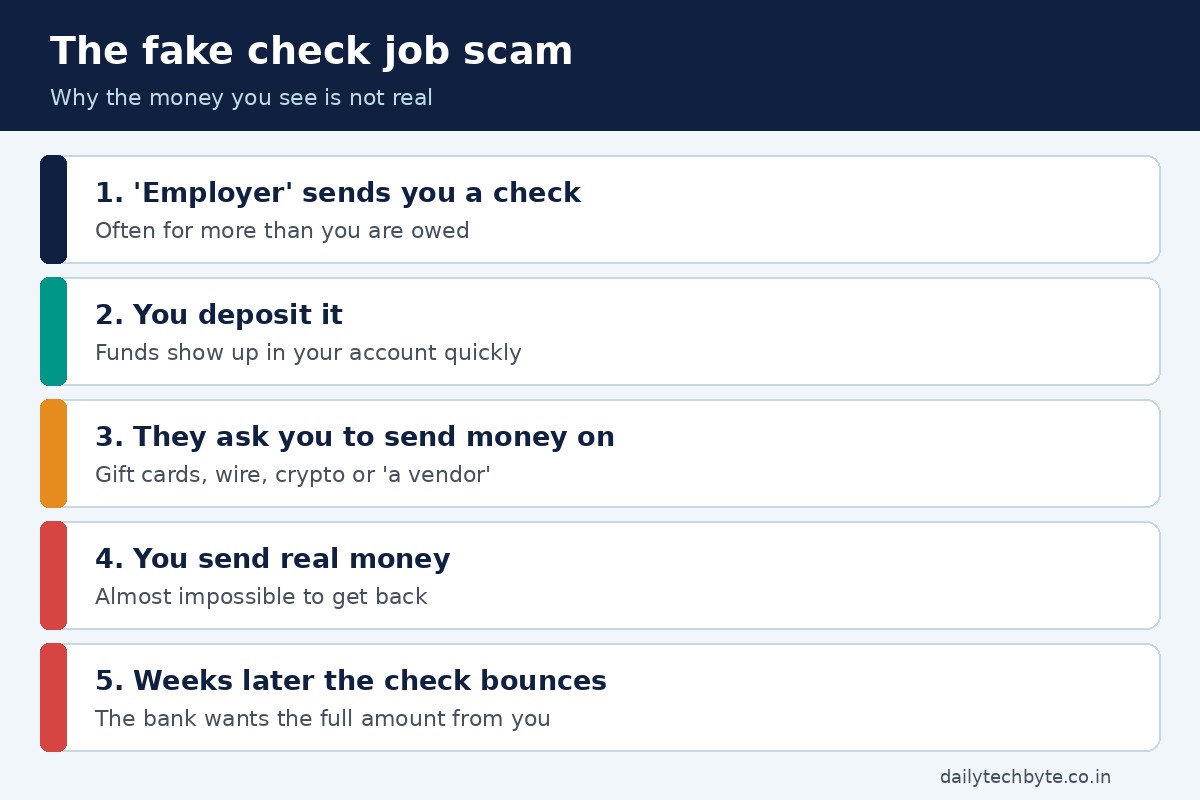
This one deserves its own section because it hurts the most. A “new employer” sends you a check, often for more than you are owed. They tell you to keep your share and send the rest to someone else, perhaps to cover supplies or a vendor, or as gift card codes.
Here is why it works. Fake checks can look just like real ones, even to bank staff. Banks must make deposited funds available quickly, so the money may show in your account. That does not mean the check is good. It can take weeks for the bank to find out. By then the money you sent is gone and the bank wants the full amount back from you.
My rule is simple: no honest employer pays you before you work and then asks for money back.
Types of job scams at a glance
| Scam type | What they ask | Telltale sign |
|---|---|---|
| Work from home | Pay for a kit, training or certificate | Big money, little effort |
| Reshipping | Receive, repackage and send parcels | Told to discard packaging and receipts |
| Mystery shopper | Deposit a check, wire money back | Payment before any real work |
| Virtual assistant or caregiver | Deposit a check, send part to someone | Check arrives first |
| Placement service | Upfront fee for “guaranteed” jobs | Candidate pays, not the company |
| Government job offer | A fee to get the job | Federal and postal jobs are free to apply for |
A safer way to verify an offer
- Do not rely on the email alone. Find the company’s official website yourself and use the contact details there, not the ones in the message.
- Ask for a real conversation. A video or phone interview with a named person is normal. A chat-only “interview” that ends with an instant offer is not.
- Keep sensitive details back. Do not share bank, card or government ID numbers until you have verified the employer and signed a real contract.
- Use trusted job sources. In the US, USAJobs.gov lists federal openings and CareerOneStop is sponsored by the US Department of Labor. Local government sites list their own vacancies.
If the details already leaked, my calm 48-hour plan after a data breach shows what to do first. And to read the message itself more carefully, see how to spot AI phishing emails.
What to do if you already paid or shared details
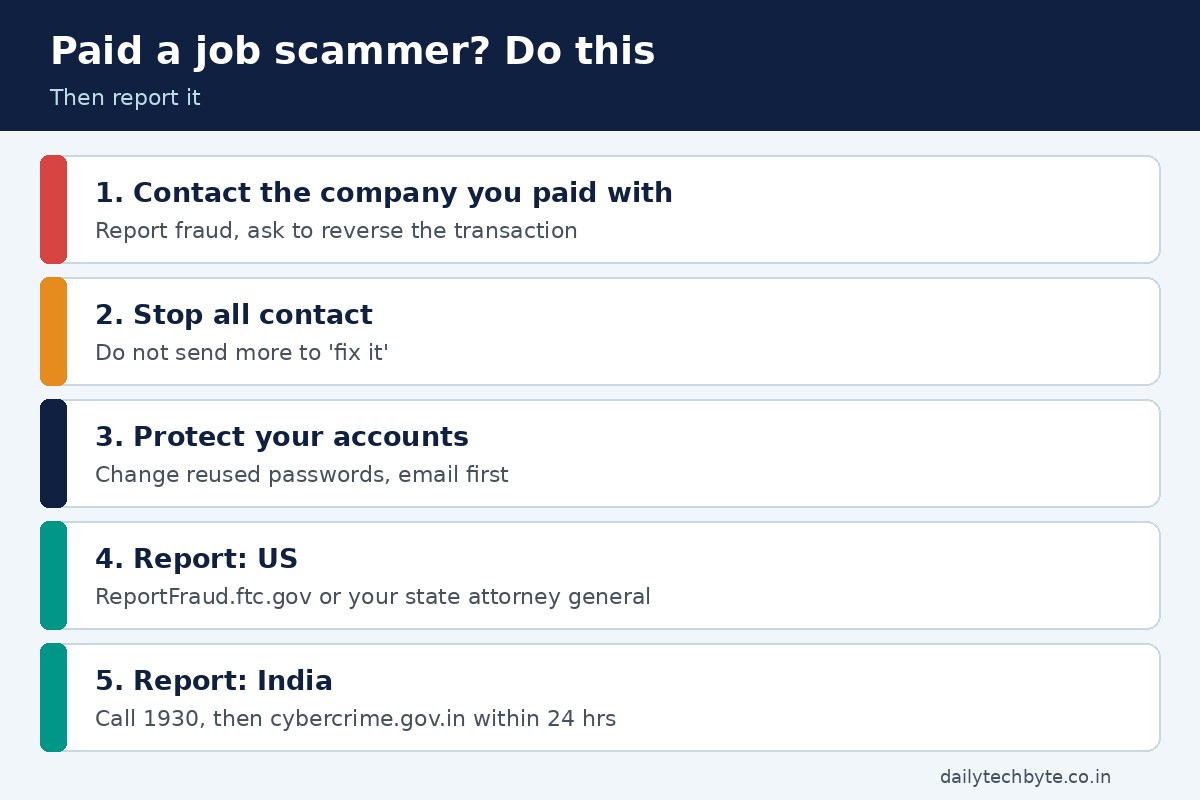
- Contact the company you used to send the money. This applies whether you paid by card, payment app, wire transfer, gift card or crypto. Report the fraud and ask for the transaction to be reversed, if possible.
- Stop contact. Do not send more “to fix it”.
- Protect your accounts. Change passwords on anything you reused, starting with your email. For a related takeover risk, read how to prevent SIM swapping on Android and iPhone.
- Report it (table below).
Where to report job scams: US and India
| Country | Where | Notes |
|---|---|---|
| US | ReportFraud.ftc.gov | For job scams, or if you lost money |
| US | Your state attorney general | Also accepts consumer complaints |
| US | US Postal Inspection Service | Also for fake check scams |
| India | cybercrime.gov.in | Register with your name and Indian mobile number (OTP) |
| India | Helpline 1930 | For financial fraud; then complete the portal complaint within 24 hours using the SMS acknowledgement number |
Common mistakes I see
- Trusting an offer because it uses a real company’s name. Names are easy to copy.
- Waiting for the first “paycheck” that never arrives.
- Sending a scanned ID “for payroll” to someone you have never spoken to.
- Feeling embarrassed and staying silent. Reporting helps the next applicant.
The bottom line
A real job offer follows a real process: you applied, you spoke to people, you signed something, and you get paid for work you did. A fake one skips straight to the part where you hand something over. Slow down, run the eight checks, and if money or a check is involved, stop.
FAQ
How can I tell if a job offer email is real?
Check that you applied, that you had a genuine interview, and that no one asks you to pay. Find the company’s official website yourself and contact them through it. Search the company name with “scam” or “complaint” too.
Do real employers ask you to pay for a job?
No. Honest employers, including the federal government, never ask you to pay to get a job. Fees for training, kits or certificates are a scammer’s tactic.
What is a fake check job scam?
A fake employer sends you a check, tells you to deposit it and send some of the money onward or buy gift cards. The check later bounces and the bank asks you to repay the full amount.
What should I do if I paid a job scammer?
Contact the company you used to send the money, report the fraud and ask for a reversal if possible. Then report the scam: in the US at ReportFraud.ftc.gov, in India on cybercrime.gov.in or helpline 1930.
Is it normal to get a job offer without an interview?
It is a warning sign. Combine it with other signs such as fees, big pay for little work or a check, and treat the offer as fake.