Last updated: November 8, 2026 · By Sanket Goyal
You cannot reliably spot an AI voice clone by listening. The safe move is to hang up and call the person back on a number you already have saved. If the call pushed you to pay money right now, in secret, by gift card, wire, crypto or a payment app, treat it as a scam until proven otherwise.
That sounds blunt, but it is what the US Federal Trade Commission tells people to do. A scammer only needs a short clip of someone’s voice, perhaps from a video posted online, and a voice-cloning program. Then the call sounds like your son, your boss or your sister. Below are six checks that work even when the voice is perfect, a table of warning signs, and where to report in the US and India.
Why a familiar voice is no longer proof
For most of history, a voice was a good ID. You knew your mother’s voice in two words. Scammers have worked out that this trust is the weak spot.
The FTC says a scammer could use AI to clone the voice of a loved one from a short audio clip, possibly taken from content posted online. When the phone rings, the caller sounds just like your relative. The US phone regulator, the FCC, has also warned that scammers use this to make it sound like friends, family, celebrities or officials are calling.
So drop the idea that you will “hear the fake”. Some clones sound flat or oddly paced. Many do not. Build your defence on process, not on your ears.
The 6 checks, in order
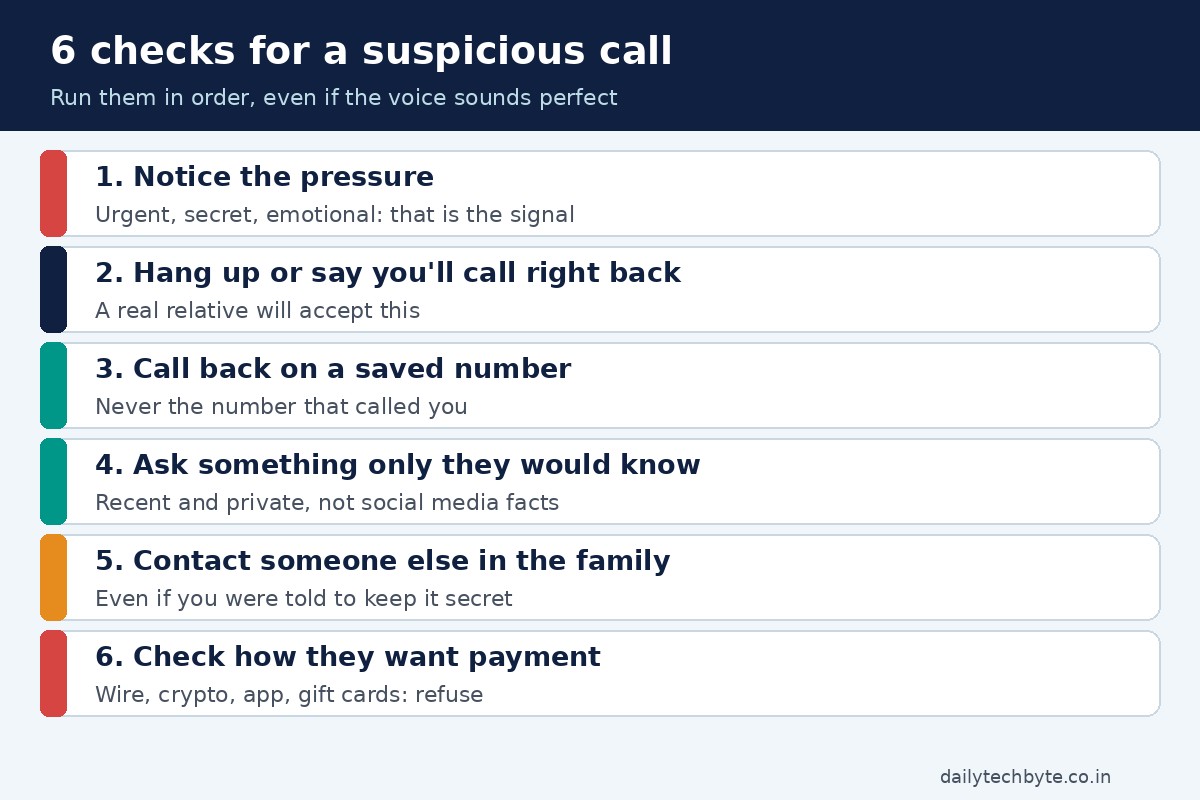
Check 1: Notice the pressure
Real emergencies are messy, but they do not usually come with a payment deadline from a stranger’s number. The FTC lists the shared pattern in these scams: it is urgent, you are the only one who can help, it must stay secret, and the caller plays with your emotions.
If you feel your heart racing and a voice saying “do it now”, that feeling is the signal. Slow down on purpose.
Check 2: Hang up, or say you will call right back
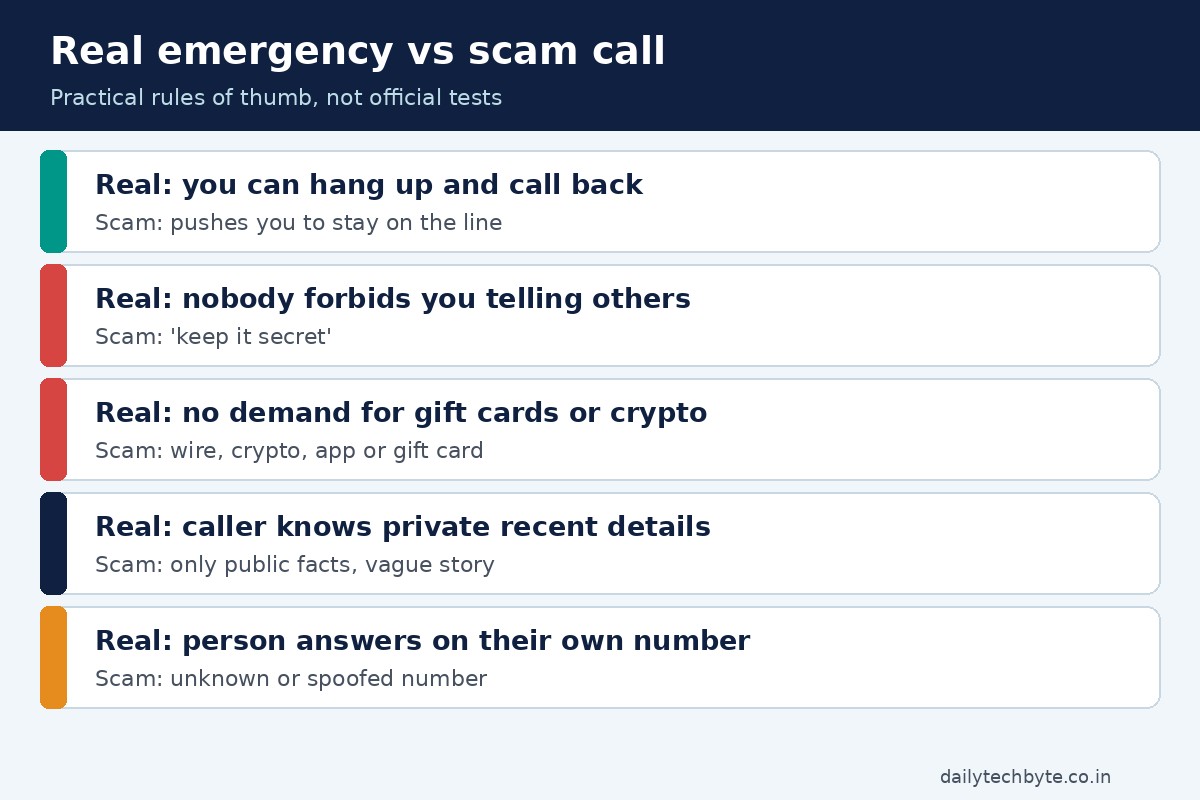
This is the single best move. The FTC advice is to resist the pressure to send money immediately, then hang up or tell the person you will call them right back.
A real relative in trouble will accept that. A script will not. Picture a retired teacher who gets a call from a “grandson” asking for bail money. She says “I’m hanging up and calling you on your number.” The call ends fast. That tells her what she needs to know.
Check 3: Call back on a number you already trust
Use the number saved in your phone, or one written in your address book. Not the number that just called you. Not a number the caller reads out.
This matters because Caller ID can be faked. The FCC explains that spoofing can make Caller ID show a “local” number even when the caller is not local. A familiar-looking number is not proof either.
Check 4: Ask something only the real person would know
If you cannot bring yourself to hang up, ask a question a stranger could not answer. The FTC’s own examples are “What kind of dog do you have?” or “Where did you spend Thanksgiving last year?”
I would go one step further and keep it recent and private. Your pet’s name may be all over social media. What you both laughed about last Sunday is not.
Check 5: Reach someone else, even if you were told to keep it secret
Scammers like secrecy because a second person breaks the spell. The FTC advises calling another family member or friend, especially when you cannot reach the person who is supposedly in trouble, and even if the caller said to keep it quiet.
A trusted person can help you sort out whether the story holds. Two minutes of that is cheap.
Check 6: Look at how they want to be paid
The FTC says scammers ask for payment in ways that make it hard to get your money back: wiring money, cryptocurrency, payment apps, or gift cards where you read out the numbers. If a “family member” or “boss” wants money by one of these, that alone is a strong sign of fraud.
Warning signs at a glance
| Sign | What it looks like | What to do |
|---|---|---|
| Urgency | “Pay in the next ten minutes” | Hang up, call back on a saved number |
| Secrecy | “Don’t tell mom” | Tell someone you trust anyway |
| Authority figure | A “lawyer”, “police officer” or “doctor” joins the call | Do not follow their payment steps |
| Odd payment method | Wire, crypto, payment app, gift cards | Refuse and verify first |
| Unknown or “local” number | Caller ID looks familiar | Remember it can be spoofed |
| Emotional script | Crying, panic, fear | Slow down on purpose |
The FTC notes that scammers sometimes pretend to be an authority figure, like a fake lawyer, police officer or doctor working with your family member, to sound more convincing and scare you.
Set up a defence before you need one
You cannot check anything calmly in the middle of a scary call. Prepare now.
- Pick a family code word. This one is my own suggestion, not an official rule. Choose a word or phrase that never appears online, share it only in person, and agree that anyone asking for urgent money must say it. If the caller cannot, you are done.
- Save key numbers properly. Make sure the people you would panic about are in your contacts under their real names.
- Tell older relatives about this scam. A two-minute chat now is worth more than any app.
- Be careful with unknown calls. The FCC advises not answering calls from unknown numbers and never giving account numbers, passwords or other identifying details to unexpected callers.
- Block and register. Ask your phone company about call-blocking tools and register your number on the Do Not Call list. It will not stop criminals, but it cuts noise.
For workplace calls, the same logic holds. A “boss” asking an accounts clerk for a quick transfer is the classic setup. Agree a rule at work: any payment request made by phone gets confirmed on a second channel, such as a known internal number, before money moves.
If you already sent money
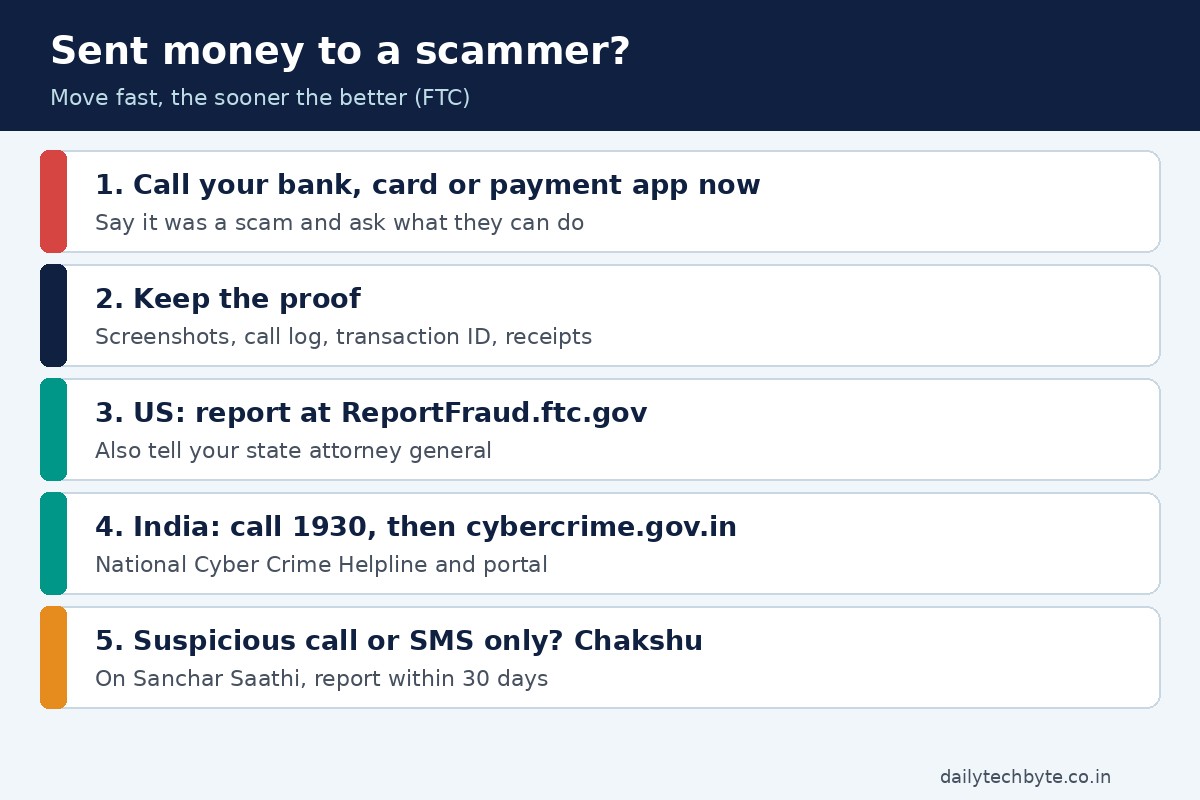
Act fast. The FTC says that no matter how you paid, the sooner you act, the better.
- Contact your bank, card company or payment app straight away and tell them it was a scam.
- Keep screenshots, call logs, transaction IDs and receipts.
- Report it, using the table below.
| Country | Where to report | Notes |
|---|---|---|
| US | ReportFraud.ftc.gov and your state attorney general | Report any scam you spot |
| US | FCC complaint (for illegal robocalls or texts) | The FCC treats AI-voice robocalls as illegal without consent, with some exceptions |
| India | Call 1930, the Cyber Crime Helpline | Use it for online financial fraud |
| India | cybercrime.gov.in | The national cyber crime reporting portal |
| India | Chakshu on the Sanchar Saathi portal | For suspected fraud calls, SMS and WhatsApp; report within 30 days for action |
| India | 112 | National police helpline for emergencies |
Chakshu is meant for reporting suspected fraud communication. If you have already lost money, the portal itself points you to 1930 or cybercrime.gov.in instead.
What the law says about AI voices on calls
The FCC has ruled that AI-generated voice calls count as robocalls under the Telephone Consumer Protection Act. In plain words, calls using voice cloning are generally illegal unless the person had given express consent to get them, with some exceptions. That helps regulators go after bulk callers. It does not stop a determined criminal who ignores the law, which is why your own checks matter more than the rule.
Related reading on this site
Voice clones are one tool in a bigger kit. If a scam starts by email instead, my guide on how to spot AI phishing emails covers the red flags. If someone offers you work and then asks for money, the fake job offer email checks apply. And if your details have already leaked, follow the 48-hour data breach plan.
The bottom line
Do not try to win a listening contest with a machine. Treat any urgent money request by phone as unverified until you have hung up and called back on a number you trust. Add a second person, refuse odd payment methods, and report quickly if something goes wrong. These habits cost nothing and work against even a perfect clone.
If this helped, send it to a parent or grandparent today. Then explore more safety guides here on DailyTechByte.
FAQ
Can you tell if a voice is AI-generated?
Not reliably. Some clones sound odd, but many sound natural. The FTC says not to trust the voice. Verify by calling the person back on a number you know is theirs.
How much audio does a scammer need to clone a voice?
The FTC says a short audio clip is enough, for example one taken from content posted online, together with a voice-cloning program. There is no safe exact number to quote.
What should I do if a call sounds like my child asking for money?
Hang up or say you will call right back. Call your child on their saved number, or reach them through another family member or friend. Do not pay until you have confirmed it.
Are AI voice robocalls illegal?
In the US, the FCC has ruled that AI-generated voice calls are robocalls under the TCPA, so they are generally illegal without the recipient’s express consent, with some exceptions.
Where do I report a voice clone scam in India?
If money was lost, call the Cyber Crime Helpline 1930 and file at cybercrime.gov.in. For suspected fraud calls, SMS or WhatsApp, you can also report on Chakshu through the Sanchar Saathi portal.