
Last updated: November 6, 2026 · By Sanket Goyal
Is 0% APR financing a good deal? Sometimes, yes. It is a good deal when it is a true 0% offer, you qualify for it, you can pay it off in time, and you did not give up a cash discount to get it. It is a bad deal when the zero is really “deferred interest”, where one missed payoff date can bring back all the interest.
The holiday sales season is exactly when these offers show up on TVs, sofas, laptops and cars. So here is how I check one before I say yes. The rules below come from US consumer protection agencies, and the questions work anywhere.
What 0% APR actually means
APR is the yearly cost of borrowing, shown as a rate. At 0% APR, the lender charges no interest for a set promotional period. You still borrow money. You still have to pay it all back. All the offer removes is the interest, and only for a while.
That sounds simple. The catch lives in the fine print: how long the period is, what the rate becomes afterwards, and whether the zero is true or deferred.
True 0% versus deferred interest
This is the part that costs people money. The US consumer finance regulator gives a quick test: look for the “if”.
- “0% intro APR for 12 months” is a true zero interest offer.
- “No interest if paid in full within 12 months” is deferred interest.
With true zero interest, nothing is added during the promo period. If a balance is left at the end, you pay interest only on what remains, and only from that date forward.
With deferred interest, interest quietly builds up in the background from the day you buy. Pay the whole balance by the deadline and it disappears. Miss it by even a little and the lender adds interest going back to the purchase date.
The regulator’s own example
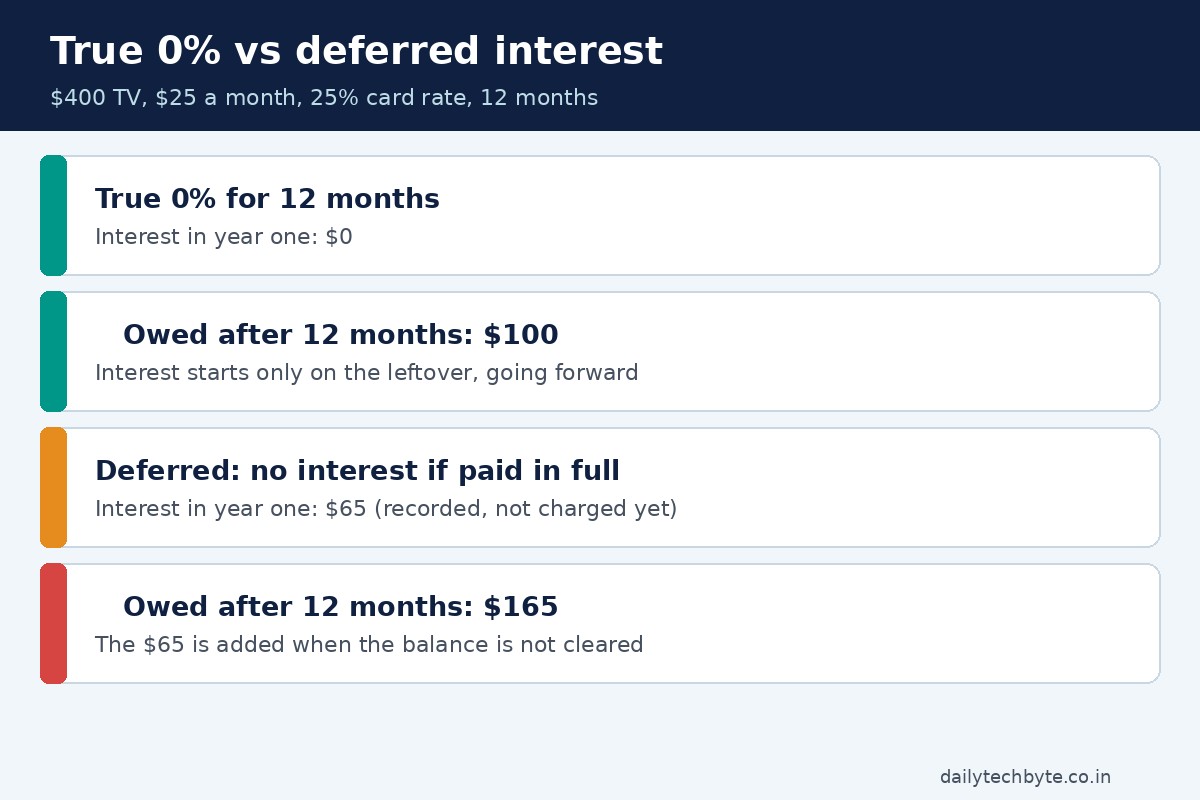
The regulator uses a $400 TV bought on a card with a 25% rate. Say you pay $25 a month for 12 months. That is $300 paid and $100 still owed when the promo ends.
| Offer type | Interest charged in year one | Owed after 12 months |
|---|---|---|
| True 0% for 12 months | $0 | $100 |
| Deferred interest, 12 months | $65 | $165 |
Same TV. Same payments. A $65 difference, just from the type of promotion. A $25 monthly payment is a “normal” looking minimum, and it still was not enough to finish the job in time.
The deferred interest rules to know
The regulator’s guidance lists several things that trip people up:
- You must pay the full balance by the end of the period, or you could owe all the interest that was being deferred.
- You still need to make at least the minimum payment on time. Being more than 60 days late can end the promotion.
- The minimum payment alone probably will not clear the balance in time.
- If your card has other balances at a higher rate, extra money above the minimum usually goes to those first. In the last two billing cycles of the promo, extra money must go to the deferred balance.
- Carrying the promo balance can cost you the grace period on new purchases, which means new purchases may start collecting interest.
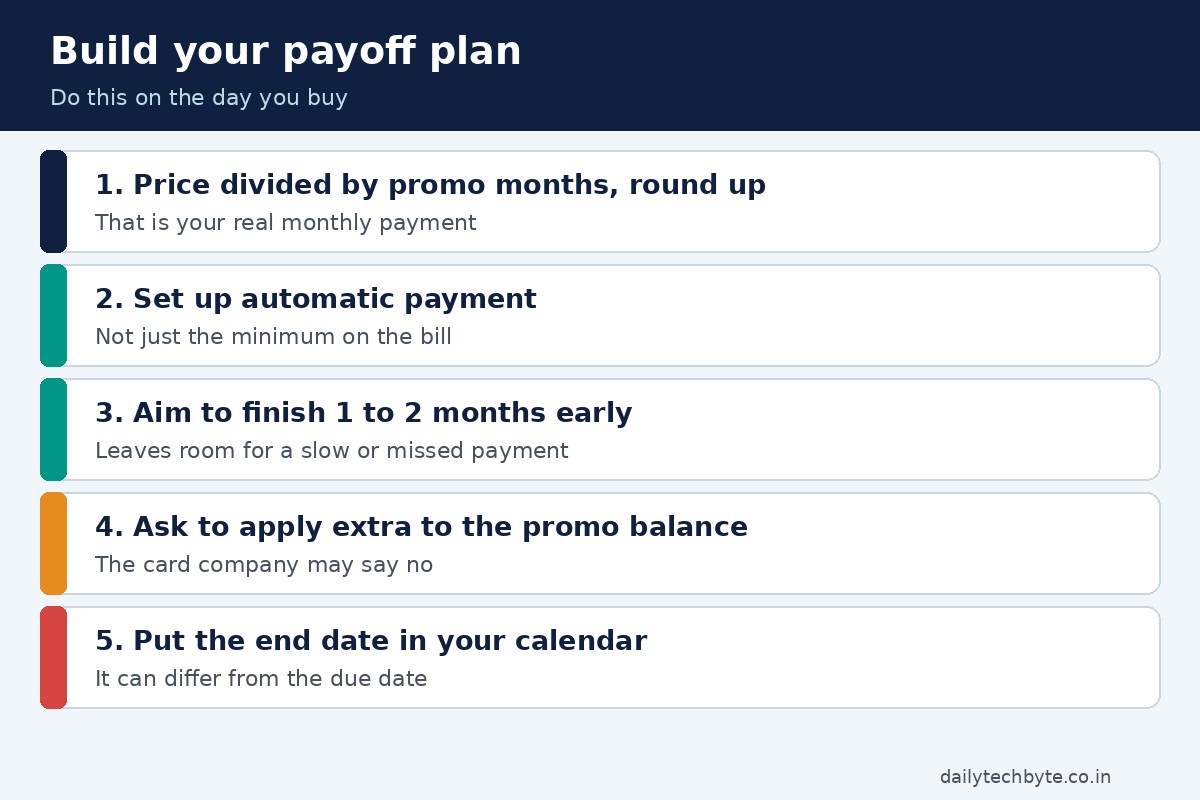
One small habit helps a lot. The end date of the promotion is printed on the front page of your bill, and it can differ from your regular due date. Put it in your calendar the day you buy.
0% APR on a car: who really gets it
For cars, the regulator says that in general only buyers with the highest credit scores qualify for 0% offers. Car makers and dealers may run these deals on models they want to move, and these deals often need a short loan, such as 36 months.
A short loan means a higher monthly payment. That can be fine if your budget can carry it. It is a problem if you stretch to afford it and then miss a payment.
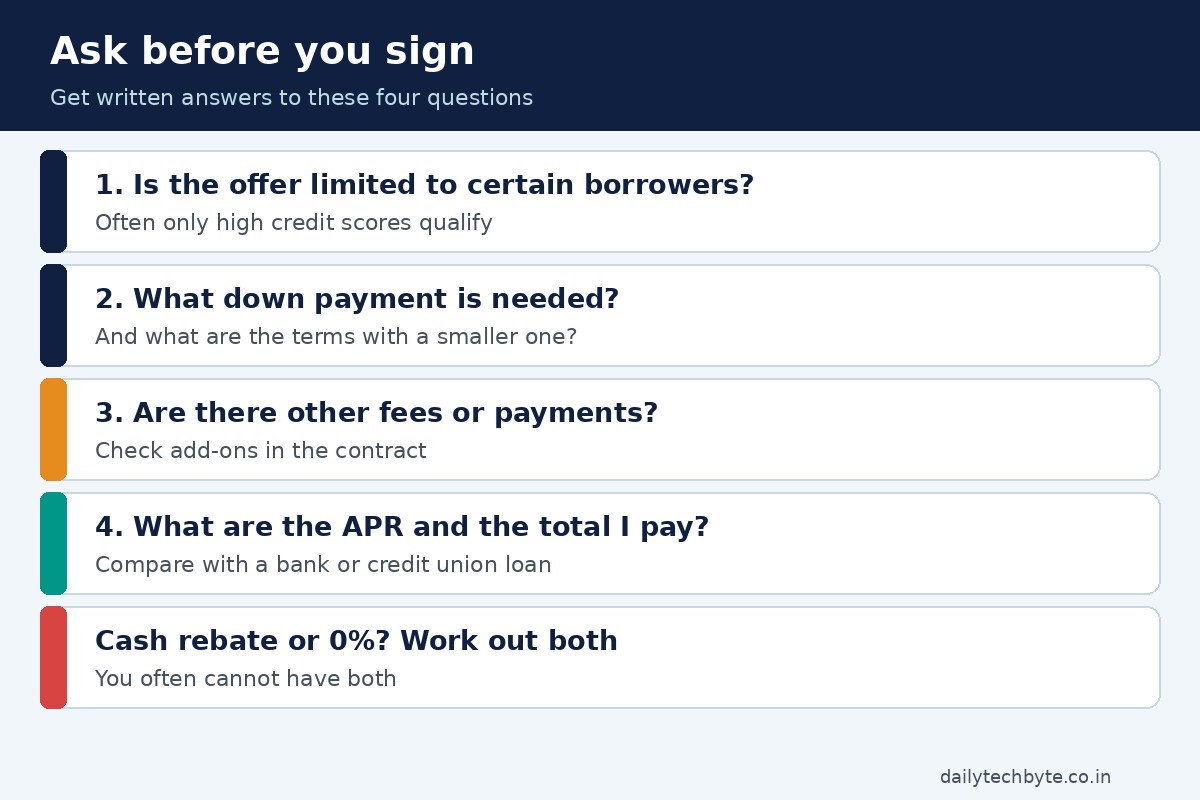
The FTC adds another warning. A low advertised rate may apply only to “highly” or “well” qualified borrowers, and ads can leave out a required down payment or other fees. Before you go, ask for answers in writing to these questions:
- Is the offer limited to certain types of borrowers?
- Do I need a certain down payment, and what are the terms if I put down less?
- Are there other fees or payments?
- What is the APR, and what is the total I will pay?
The cash rebate trade-off
Here is the question many buyers never ask. The regulator notes that incentives can include 0% APR loans and also manufacturer cash rebates. If the offer is “0% or a cash rebate”, you often cannot have both. I would work out both versions before choosing. A bank or credit union loan plus a rebate can sometimes cost less than 0% with no rebate. I cannot promise that for your deal, so do the sum with real numbers.
The FTC also suggests getting preapproved for a loan from a bank or credit union before you deal with the dealer’s finance office. With a preapproval in hand, you can see whether the dealer’s offer is truly good, and you have leverage to negotiate.
A quick test: should you take it?
Picture a freelance designer eyeing a $1,200 laptop on a 12-month plan. Before signing, she asks three things: Is it true 0% or deferred? Can she pay $100 a month without strain? What happens if one month goes wrong? If she has the cash flow and the plan is true 0%, it is a decent way to spread a cost. If it is deferred and her income is uneven, she is better off saving for two months and paying once.
| Question | Good sign | Warning sign |
|---|---|---|
| Wording of the offer | “0% intro APR” | “No interest if paid in full” |
| Monthly amount | Purchase divided by months fits your budget | Only the minimum payment fits |
| Qualification | You already meet the credit requirement | Offer is for “well qualified” buyers only |
| Rebate | You compared 0% with the cash option | You were never told about a rebate |
| End date | In your calendar | You are not sure when it ends |
How to pay it off safely
The method is dull and it works.
- Divide the price by the number of promo months, then round up. That is your real monthly payment, not the minimum on the bill.
- Set up automatic payment for that amount.
- Aim to finish a month or two early, so a slow payment or a forgotten last installment does not cost you.
- Ask the card company to apply amounts above the minimum to the promotional balance. They may say no, but the regulator suggests asking.
- Avoid new purchases on the same card while you are paying it down.
Common mistakes
- Paying only the minimum and assuming the promo will take care of itself.
- Confusing a 0% intro APR with a “no interest if paid in full” plan.
- Taking the 0% offer without checking the cash rebate.
- Stretching to a short loan the monthly budget cannot carry.
- Forgetting the promo end date, which may differ from the due date.
- Letting the advertised monthly payment hide add-ons or fees in the contract.
The bottom line
A true 0% offer you can pay off early is cheap money. A deferred interest offer you might not finish is a trap with a friendly label. Read the wording, do the monthly math, ask about the rebate, and get terms in writing. If the dealer will not put it in writing, walk away.
Money is also a stress factor for countries, not just families. If you like the big picture, see what a high debt to GDP ratio means for a country. And if you are sorting out your own accounts, how to withdraw money from PostPe without charges and Paytm Payments Bank alternatives may help.
FAQ
Is 0% APR financing really free?
There is no interest during the promo period, but you still repay the full amount. It can also cost you in other ways, such as a lost cash rebate, fees, or a higher rate after the promo ends.
What is the difference between 0% APR and deferred interest?
With 0% APR, no interest is added during the promo, and interest starts only on what is left afterwards. With deferred interest, interest builds from the purchase date and is added in full if you do not pay off the balance in time.
Who qualifies for 0% APR car financing?
In general, only buyers with the highest credit scores. Offers may also require a short loan term, such as 36 months.
Is it better to take 0% APR or a cash rebate?
It depends on the numbers. Compare the total cost of the 0% loan with the total cost of a loan from your bank or credit union after the rebate is applied.
What happens if I miss a payment on a 0% offer?
You may owe late fees. If you are more than 60 days late on a deferred interest plan, you could lose the promotion and be charged the deferred interest.